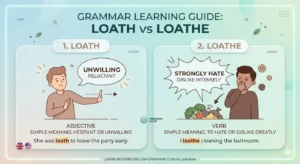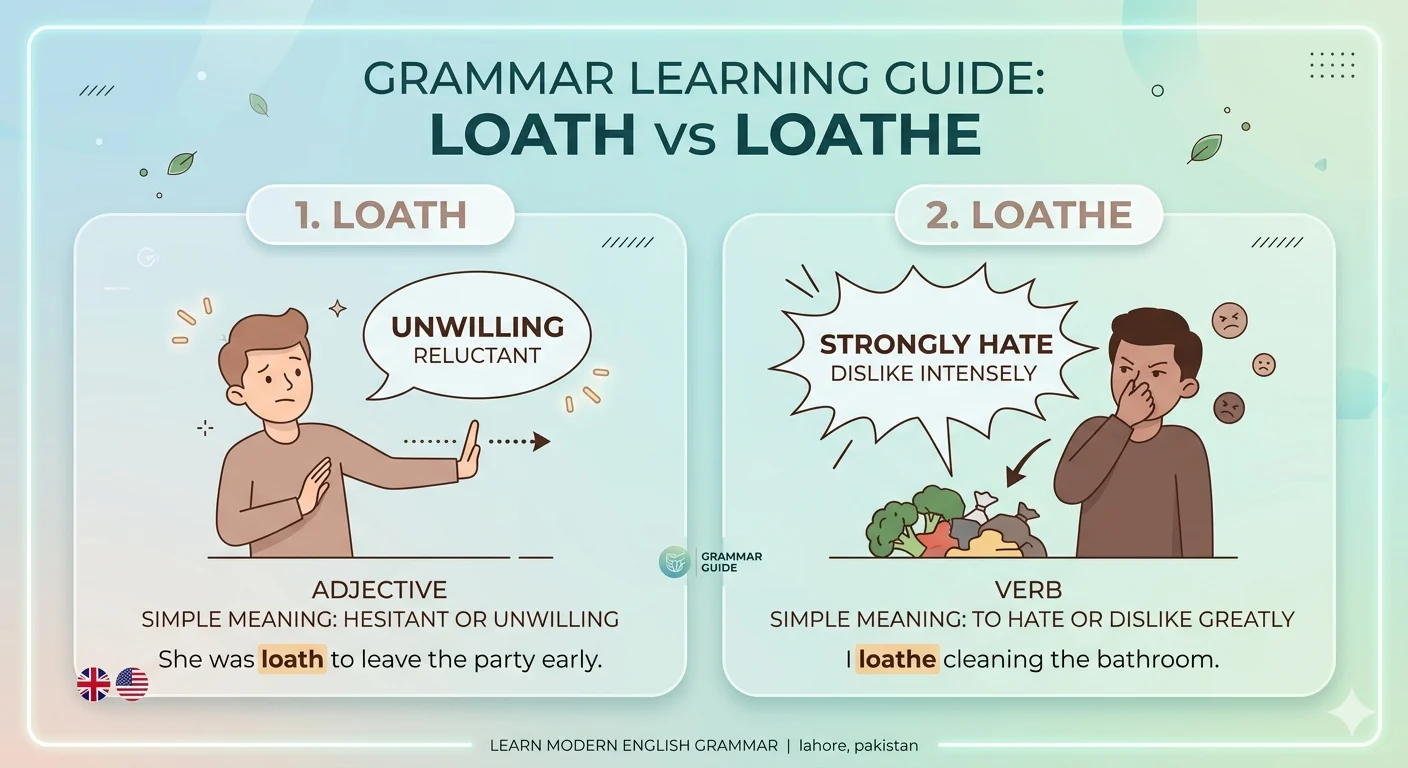
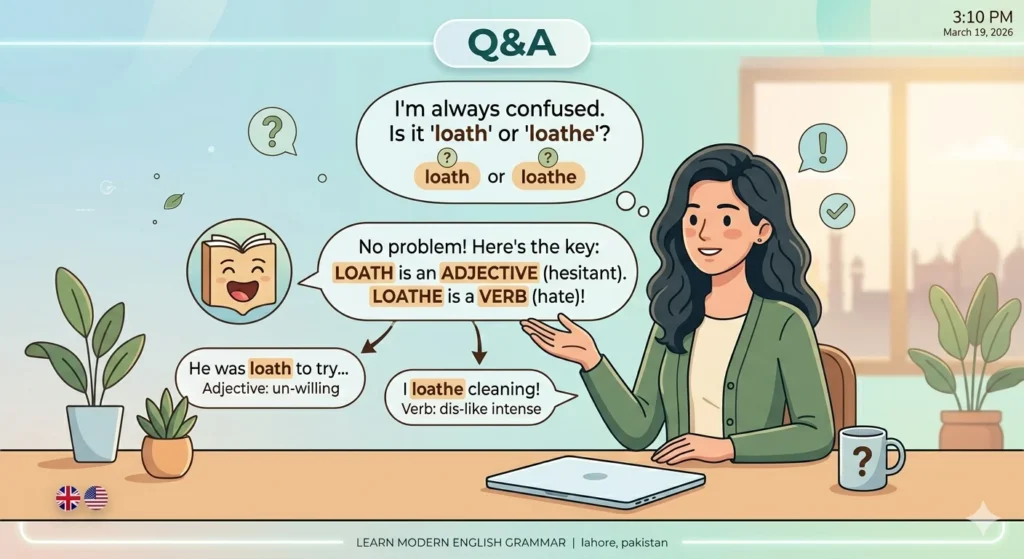
Loath means unwilling or reluctant.
Loathe means to hate or strongly dislike.
Simple Examples
- I am loath to admit I was wrong. (reluctant)
- I loathe dishonesty. (hate)
Easy Rule
- Loath = feeling reluctant
- Loathe = action of hating
If you say I loathe to admit, it is incorrect because loathe needs an object to h
English learners and even native speakers often confuse loath vs loathe because the words look almost identical but carry very different meanings. A single missing letter completely changes how the word works in a sentence. Many people search this topic when writing emails, essays, or professional content and suddenly wonder: Is it loath to admit or loathe to admit? The confusion grows because both words relate to dislike, yet one is an adjective while the other is a verb.
Understanding this difference helps you avoid common grammar mistakes and sound more confident in writing. Whether you are preparing formal documents, posting on social media, or improving everyday English, knowing when to use each word matters. This guide explains loath vs loathe meaning, pronunciation, usage, examples, and real-life applications in the simplest way possible.
The Origin of loath vs loathe
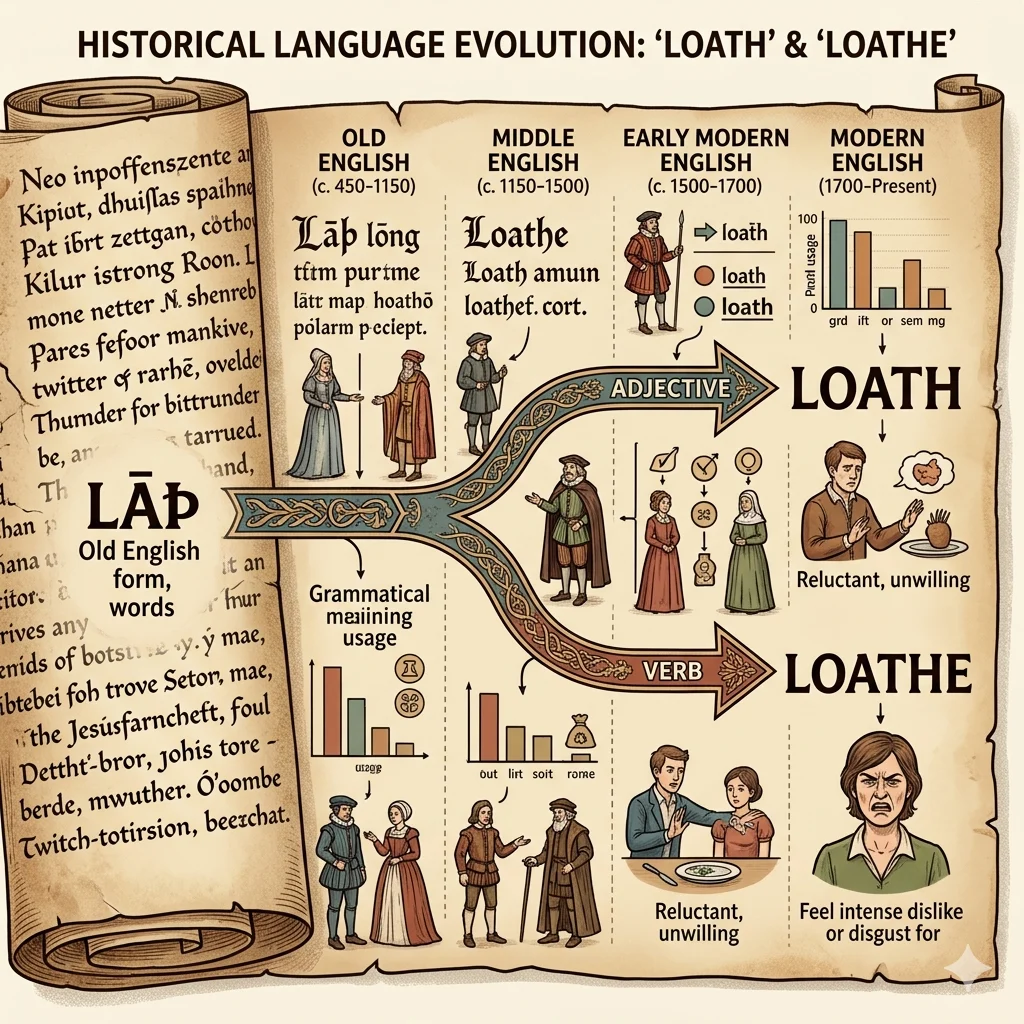
The confusion between loath vs loathe comes from their shared linguistic history. Both words developed from Old English roots connected to dislike and resistance, but over time they evolved into different grammatical roles.
Loath comes from the Old English word lāth, meaning hateful, unpleasant, or reluctant. Over centuries, its meaning softened and became associated mainly with unwillingness rather than hatred.
Loathe appeared later as a verb form built from the same root. English speakers added the silent “e” to create an action word meaning to feel intense dislike.
Why the spelling difference exists
English often creates verbs by adding letters or endings to adjectives. The extra “e” signals that the word performs an action.
- loath → describes a feeling
- loathe → expresses an action
Because pronunciation is similar, writers often mix them up, especially in fast typing or speech-to-text writing.
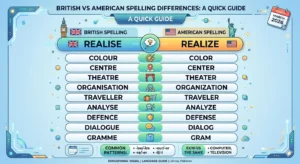
British English vs American English Spelling
Unlike many English word pairs, loath vs loathe is not mainly a British vs American spelling issue. Both forms exist in both language systems with the same meanings.
However, usage frequency differs slightly across regions.
| Feature | British English | American English |
|---|---|---|
| Loath usage | Common in formal writing | Common but slightly less frequent |
| Loathe usage | Very common | Very common |
| Meaning difference | Same | Same |
| Grammar role | Adjective vs verb | Adjective vs verb |
| Spelling variation | None | None |
Examples
British style:
- She was loath to complain.
American style:
- I loathe rude behavior.
The spelling rules remain identical worldwide, which means errors come from grammar confusion rather than regional spelling.
Aesthetics Vs Esthetics 🧠 One Small Difference
Which Spelling Should You Use?
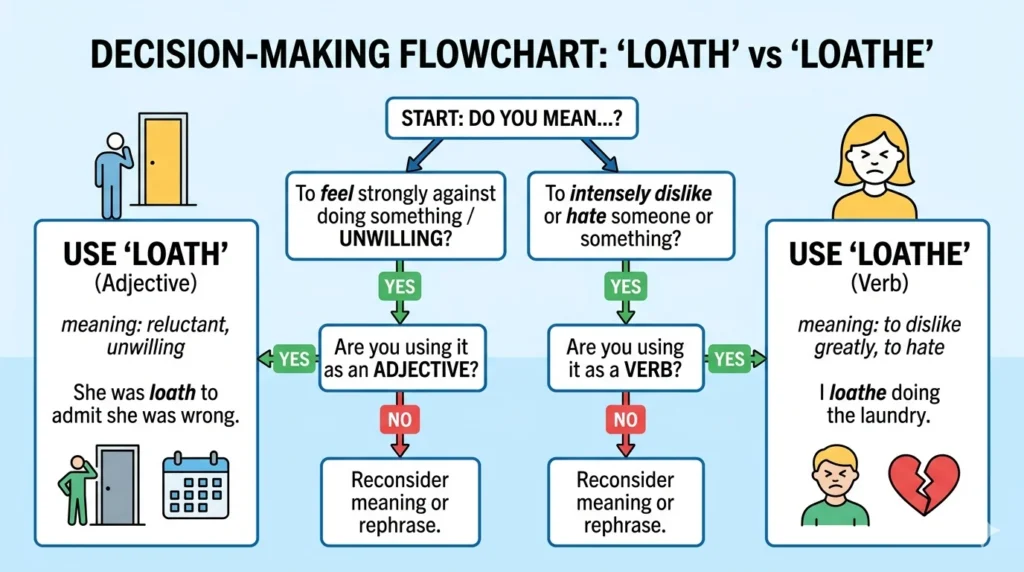
Choosing between loath vs loathe depends entirely on meaning, not location.
Use loath when:
- You feel reluctant.
- You hesitate to do something.
- You describe emotional resistance.
Example:
- I am loath to change my decision.
Use loathe when:
- You express strong dislike.
- You hate something actively.
- The sentence needs a verb.
Example:
- I loathe spam emails.
Audience-Based Advice
| Audience | Best Choice |
|---|---|
| US readers | Follow meaning rule |
| UK readers | Same usage applies |
| Commonwealth countries | Same grammar standard |
| Global audience | Prefer simple sentences with clear context |
If unsure, replace the word with reluctant or hate to test meaning.
Common Mistakes with loath vs loathe
Many grammar errors appear because people assume both words mean hate.
Mistake 1: Using loathe instead of loath
❌ I am loathe to admit my mistake.
✅ I am loath to admit my mistake.
Mistake 2: Using loath as a verb
❌ I loath noisy places.
✅ I loathe noisy places.
Mistake 3: Assuming loath means hate
Loath does not mean hate directly. It means unwilling.
Mistake 4: Missing object after loathe
❌ I loathe to go.
✅ I loathe crowded markets.
Quick Correction Tip
If the word can be replaced with reluctant, choose loath.
If it can be replaced with hate, choose loathe.
loath vs loathe in Everyday Examples
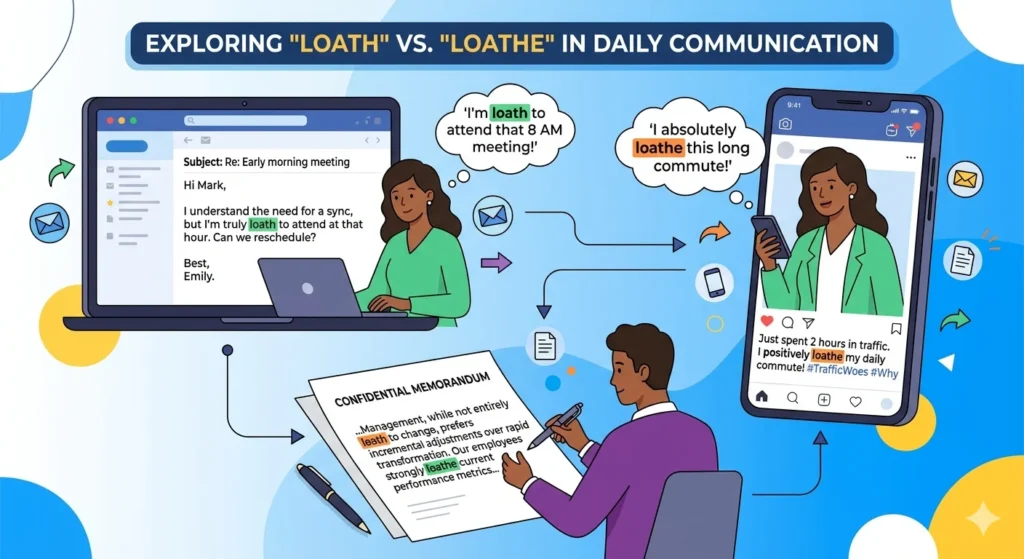
Understanding real-life usage makes the difference clear.
Emails
- I am loath to delay the meeting again.
- I loathe unnecessary reply-all messages.
News Writing
- The minister was loath to comment on rumors.
- Citizens loathe corruption scandals.
Social Media
- I loathe spoilers!
- I am loath to wake up early today.
Formal Writing
- Researchers were loath to publish incomplete results.
- Many critics loathe predictable storytelling.
loath and loathe in a sentence
- She was loath to speak, but she loathed silence even more.
loath in a sentence
- He felt loath to leave his hometown.
I loathe you meaning
It expresses intense dislike or emotional rejection toward someone.
loath vs loathe – Google Trends & Usage Data
Search behavior shows strong interest in this word pair because spelling similarity causes confusion.
Popularity by Context
- Students search during essay writing.
- Professionals search while drafting emails.
- Bloggers search for grammar accuracy.
Geographic Usage Trends
| Region | Common Search Intent |
|---|---|
| United States | Grammar correction |
| United Kingdom | Formal writing clarity |
| India & Pakistan | English learning |
| Australia | Academic writing |
| Canada | Style improvement |
The phrase I am loathe to meaning and pronunciation questions appear frequently, showing users want practical understanding rather than dictionary definitions.
Realises Vs Realizes ⚡ The Shocking Grammar Difference
Comparison Table: loath vs loathe
| Feature | Loath | Loathe |
|---|---|---|
| Part of speech | Adjective | Verb |
| Meaning | Reluctant | Hate strongly |
| Usage | Before infinitive | With object |
| Example | Loath to admit | Loathe dishonesty |
| Pronunciation | /loʊθ/ | /loʊð/ |
| Function | Describes feeling | Shows action |
Pronunciation Guide
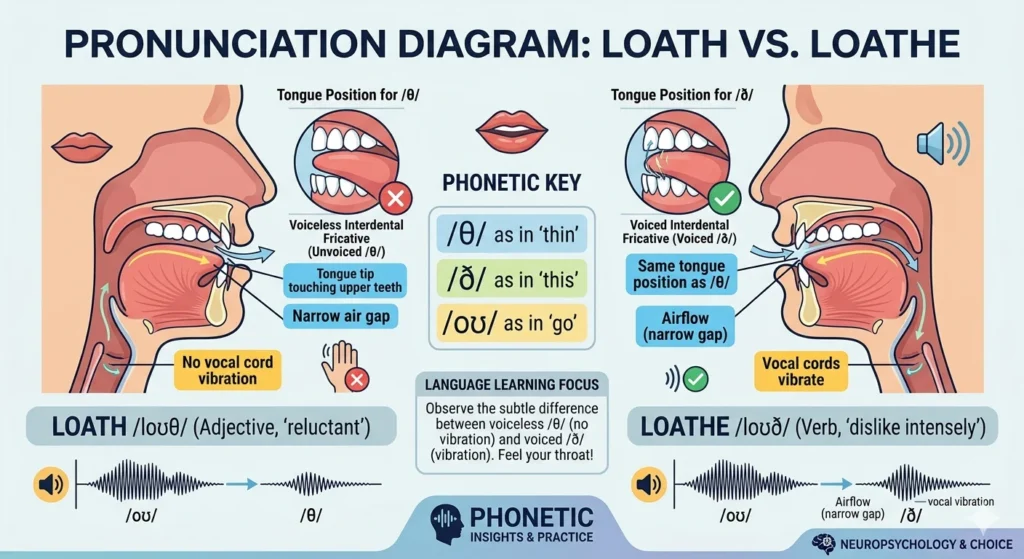
Many learners struggle with loath vs loathe pronunciation.
- Loath → ends with soft “th” sound (like bath).
- Loathe → ends with voiced “th” sound (like breathe).
Practice:
- Loath → lowth
- Loathe → low-th (vibration in throat)
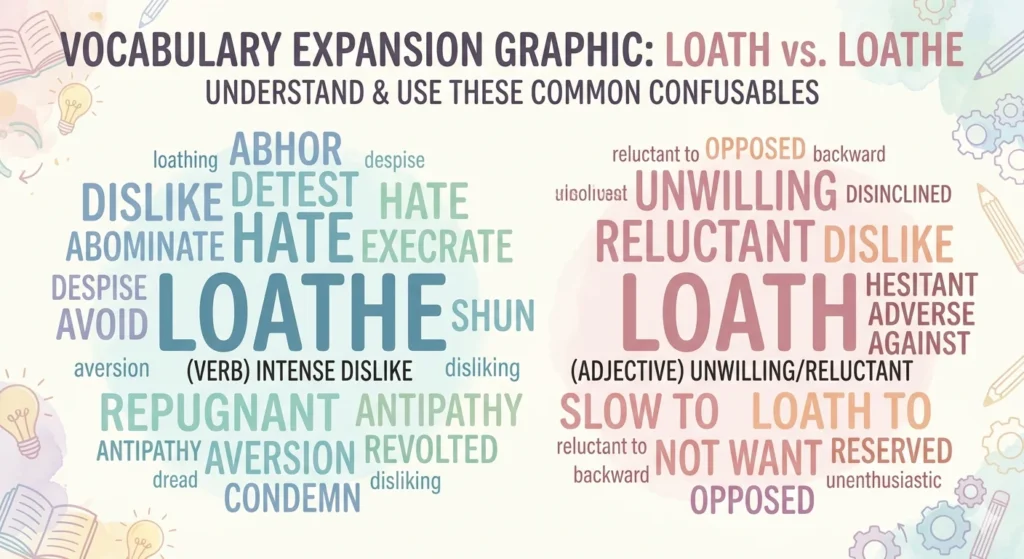
Synonyms
Loath synonyms
- reluctant
- unwilling
- hesitant
- resistant
Loathe synonyms
- hate
- detest
- despise
- abhor
Knowing synonyms helps confirm correct meaning during writing.
FAQs
1. Is it loath to admit or loathe to admit?
Correct phrase: loath to admit, because it means reluctant.
2. Does loath mean hate?
No. Loath means unwilling or reluctant, not hate.
3. Is “I am loathe” grammatically correct?
Usually no. You should say I am loath unless you are using loathe as a verb.
4. Is it loathe or loath to do something?
Correct form: loath to do something.
5. What is the difference between loath vs loathe meaning?
Loath describes reluctance; loathe expresses strong dislike.
6. How do you remember the difference easily?
Loathe has an extra “e” for emotion and action.
7. Can both words appear in one sentence?
Yes: She was loath to join people she loathed.
Conclusion

The difference between loath vs loathe becomes simple once you understand their roles. Although the words share historical roots and similar pronunciation, they function differently in grammar. Loath is an adjective describing reluctance, while loathe is a verb expressing strong dislike or hatred. Most mistakes happen when writers assume both words mean hate or when they forget that loathe needs an object.
A reliable strategy is substitution. If you can replace the word with “reluctant,” use loath. If “hate” fits better, use loathe. This small check instantly improves clarity and prevents embarrassing grammar errors in professional writing.
Correct usage strengthens communication across emails, academic work, journalism, and social media posts. Because English learners worldwide search this topic frequently, mastering the distinction gives you a clear advantage in accurate expression. With practice, recognizing context becomes automatic, and choosing between the two words feels natural rather than confusing.
Remember: one letter changes everything. Understanding this subtle difference helps your writing sound precise, polished, and confident every time you communicate.

Sarah Hall, a passionate voice at SimileHub.com, blends poetic depth with clear guidance to help writers craft vivid imagery and unforgettable expressions.