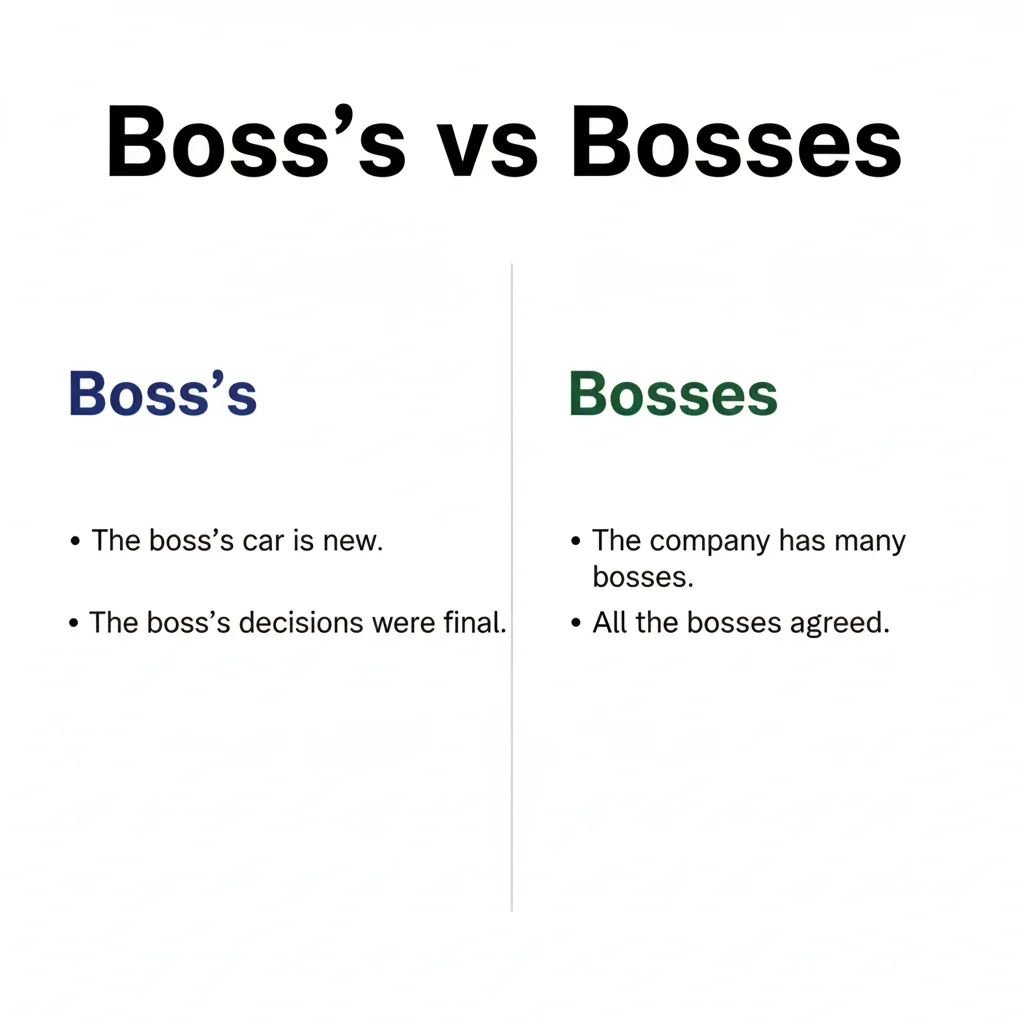
Boss’s shows possession (one boss owns something).
Bosses is the plural form (more than one boss).
Examples:
- ✅ My boss’s office
- ✅ All bosses attended the meeting
| Form | Type | Meaning |
|---|---|---|
| boss | singular | one boss |
| bosses | plural | many bosses |
| boss’s | singular possessive | belongs to one boss |
| bosses’ | plural possessive | belongs to many bosses |
Many writers get confused between boss’s vs bosses because one small apostrophe changes the entire meaning of a sentence. Is it my boss’s office or my bosses office? Should you write Bosses Day or Boss’s Day? These questions appear often in emails, workplace messages, school writing, and professional communication.
The confusion happens because English uses different rules for plurals and possession. Bosses refers to more than one boss, while boss’s shows that something belongs to a single boss. Mixing them up can make writing look incorrect or unprofessional.
This guide explains the difference between boss’s and bosses in simple language. You will learn the correct spelling, grammar rules, real examples, and common mistakes so you can use both forms confidently in everyday writing.
The Origin of boss’s vs bosses
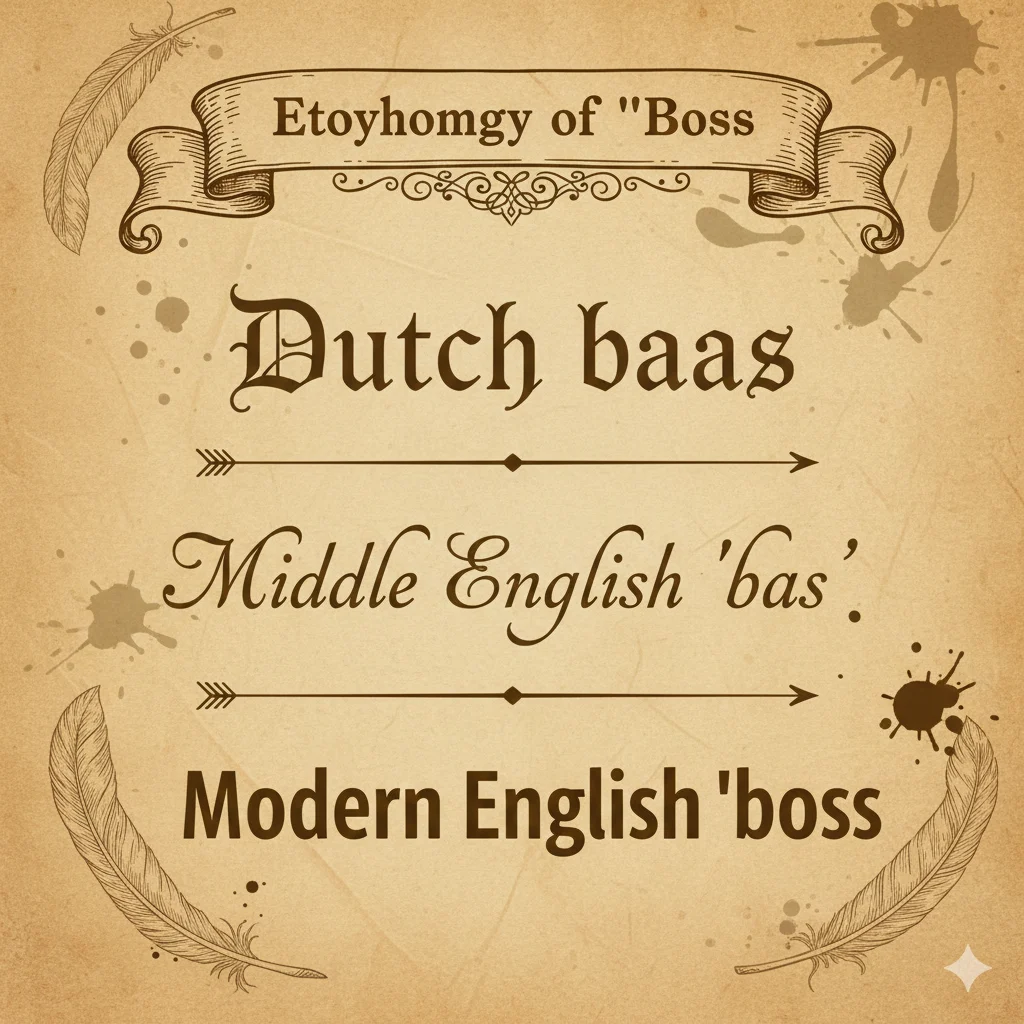
The words boss’s and bosses come from the base word boss. The word “boss” began in English in the early 19th century, borrowed from Dutch baas, meaning “master” or “leader.” English grammar later added rules for plural and possessive forms.
In English, plurals often add ‑es when a word ends in ‑s. So boss becomes bosses. For possession (showing something belongs to someone), English adds an ’s to the end of a noun. That’s why one boss owns something = boss’s.
Older forms of English had different ways to show possession, but modern English uses the apostrophe form to avoid confusion. That is why spelling differences exist today and why many learners search for boss’s vs bosses — to know when to add an apostrophe or not.
British English vs American English Spelling
Both British and American English use bosses for plural. Both also use boss’s for singular possessive. However, punctuation rules around apostrophes sometimes differ slightly.
| Rule | American English | British English |
|---|---|---|
| Plural of boss | bosses | bosses |
| Singular possessive | boss’s | boss’s |
| Plural possessive | bosses’ | bosses’ |
| Style notes | Usually add ’s even if word ends in s | Sometimes drop extra ’s sound in speech |
Examples:
- AmE: My boss’s request.
- BrE: My boss’s request.
- AmE: All bosses’ decisions matter.
- BrE: All bosses’ decisions matter.
The key difference is not the words but how strictly style guides treat apostrophe sounds. For most writers around the world, these forms work the same way.
He vs Him: The Secret to Perfect English Sentences 🤫
Which Spelling Should You Use?
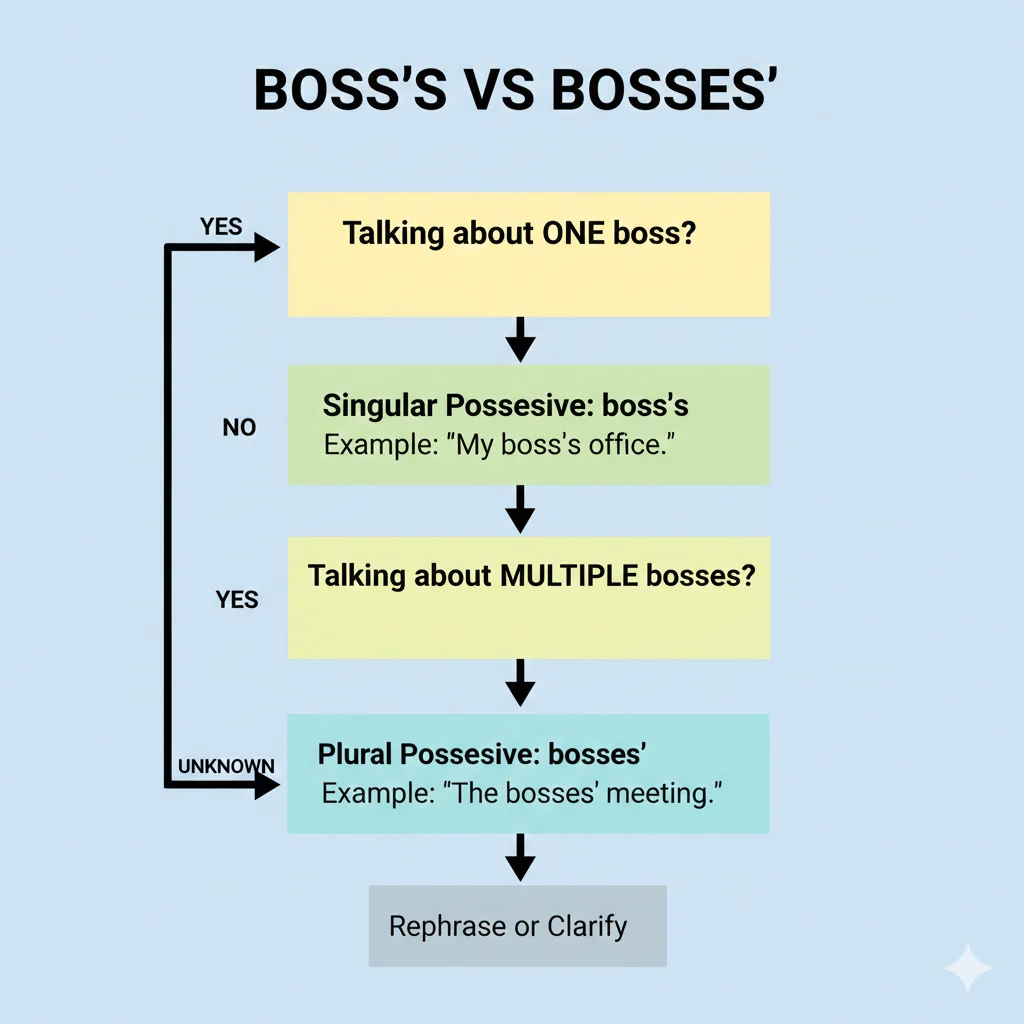
If you write in American English
Use boss’s for one boss who owns something. Use bosses for more than one boss.
Example:
- My boss’s ideas are good.
- All my bosses work together.
If you write in British/Commonwealth English
The same rules apply: boss’s for the singular possessive and bosses for the plural.
If you write for a global audience
Stick with the general rule:
- boss’s = show ownership.
- bosses = more than one boss.
Keep sentences simple. This clear way pleases both readers and search engines. Writers worldwide follow these rules in emails, blogs, and business writing.
Common Mistakes with boss’s vs bosses
Here are frequent errors and corrections:
❌ My bosses office is big.
✔ My boss’s office is big. (one boss owns it)
❌ The boss’s are in a meeting.
✔ The bosses are in a meeting. (plural, no ownership)
❌ Bosses’s rule is strict.
✔ Bosses’ rule is strict. (many bosses own rule)
❌ Is it boss’s day today? (Sometimes spelled this way but see below)
✔ Is it Bosses Day today? (Holiday with capital letters)
boss’s vs bosses in Everyday Examples
In Emails
- Please get my boss’s signature.
- All bosses must attend the meeting.
In News Headlines
- Bosses’ New Rules Affect Workers
- CEO and Bosses Agree on Plan
On Social Media
- Happy Bosses Day to all leaders!
- My boss’s advice changed my life.
In School or Formal Writing
- “The boss’s decision was final.”
- “Many bosses attended the conference.”
These examples show how the apostrophe changes meaning clearly.
Laid vs Lain: Learn the Rule in 60 Seconds ⏱️
boss’s vs bosses – Google Trends & Usage Data
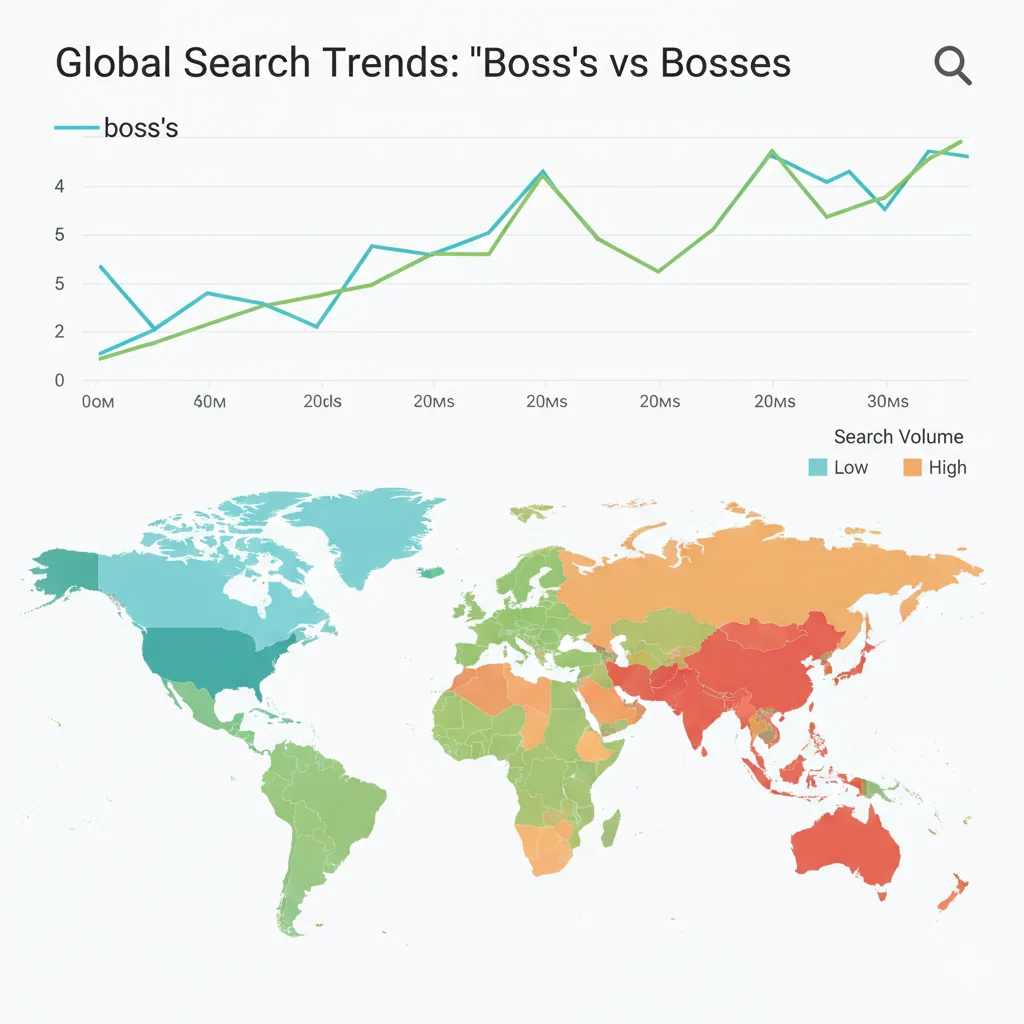
People search for this phrase most when they want grammar help. Searches for boss’s day or bosses day peak around the holiday. Others search Is it my boss’s or bosses because they aren’t sure about the apostrophe. Worldwide, English learners in the US and UK have similar questions. Many blog posts and Q&A sites compare boss’s vs bosses to help writers.
Bosses Day or Boss’s Day?
Explain clearly:
- Official holiday name = Bosses Day
- No apostrophe
- Celebrates multiple bosses
In American usage, “Bosses Day” is a recognized holiday on October 16. In British English, the celebration exists too, but it may not be as widely known.
Comparison Table: Keyword Variations Side by Side
| Form | Type | Meaning |
|---|---|---|
| boss | singular noun | one boss |
| bosses | plural noun | more than one boss |
| boss’s | singular possessive | belongs to one boss |
| bosses’ | plural possessive | belongs to more than one boss |
| Bosses Day | holiday name | day to honor bosses |
FAQs
1. Is it my boss’s or bosses?
It is my boss’s when something belongs to one boss. Use bosses for more than one boss.
2. Are bosses and boss’s both correct?
Yes — bosses is plural and boss’s is singular possessive.
3. What is the meaning of boss’s?
It shows ownership by one boss, e.g., my boss’s car means the car belongs to my boss.
4. Is it boss’s day or bosses?
The holiday is Bosses Day — plural without apostrophe in the name.
5. Boss or Boss’s Day – which?
Bosses Day honors all bosses, not just one boss’s day.
6. What does boss’s boss mean?
It means the person who leads your boss (two levels up).
7. How do you pronounce bosses?
It’s pronounced “boss‑ez.” Boss’s sounds the same in speech.
Conclusion
Understanding boss’s vs bosses is simple when you know the basic rules. Use bosses when you talk about more than one boss. Use boss’s when one boss owns something. These rules work in American and British English, with only small style differences. Many people get confused because apostrophes look like small marks — but they change meaning. A missing apostrophe can make a sentence unclear.
Knowing when to add ’s helps in emails, reports, schoolwork, and social media posts. It also makes your writing look professional. Around October, people ask if it is boss’s day or bosses day — the holiday name is Bosses Day and celebrates all bosses. Always remember: apostrophes show possession. Plurals just add ‑es.
When you check your writing, ask: “Am I showing ownership or counting bosses?” That question solves most errors. bosses counts people, boss’s shows ownership. One small apostrophe can completely change meaning.You now have tables, clear rules, and examples to guide you. Practice these rules in real sentences, and writing about bosses will feel natural.

Tessa Hadley, a reflective voice at SimileHub.com, transforms everyday moments into vivid imagery, guiding writers to create powerful, expressive comparisons.