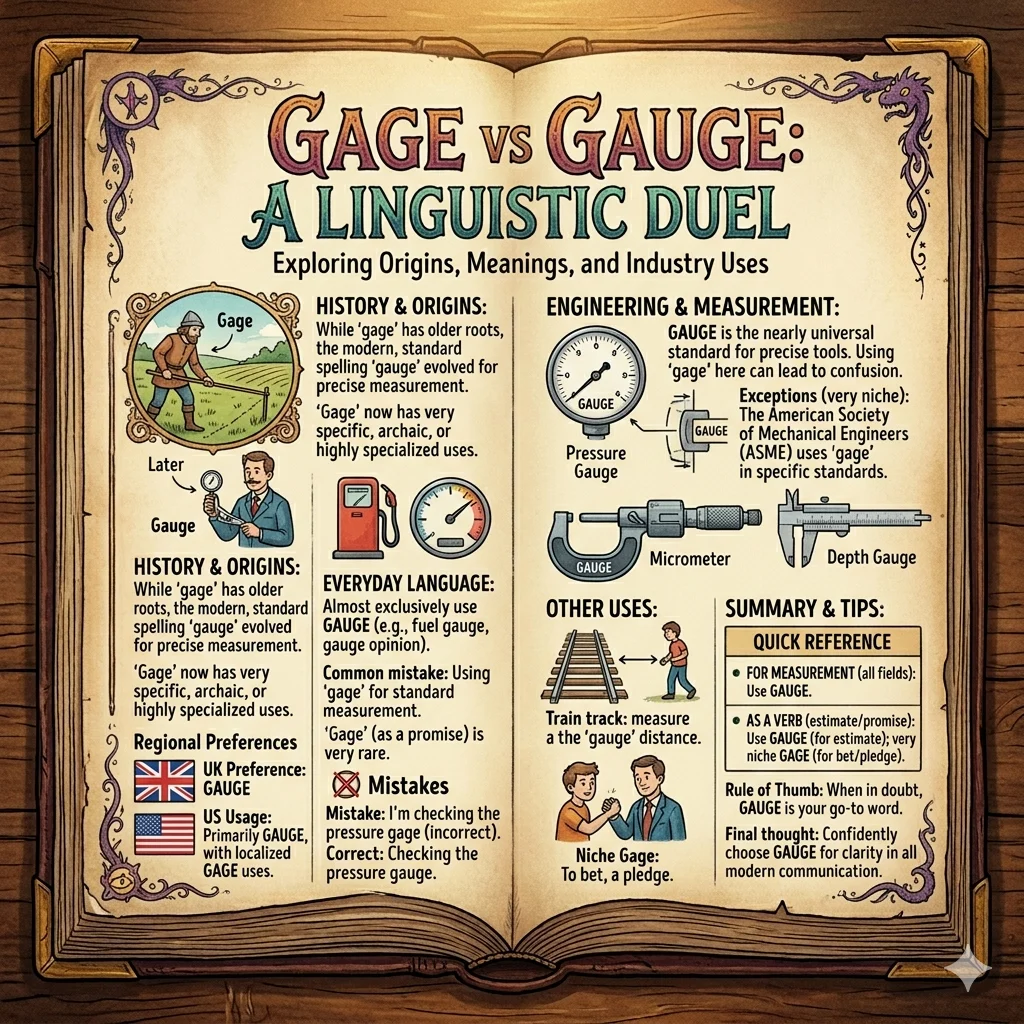
Gage vs. gauge: “gauge” is the standard and far more common spelling for a measuring instrument, measurement, or the act of estimating something. “Gage” is a less common variant used in some specialized contexts and names.
Confused about gage vs. gauge? The difference is easier than it looks—and in most everyday writing, gauge is the spelling you want. Whether you’re talking about a pressure gauge, measuring the thickness of metal, or trying to gauge someone’s reaction, gauge is the standard choice.
So, is gage wrong? Not necessarily. Gage is a legitimate variant of the word, but it is much less common in general English. You may encounter it in certain technical or specialized uses, historical contexts, or proper names. That’s why simply calling “gage” a misspelling would be misleading.
The key is knowing when to use gauge and when gage may be appropriate. If you’re writing an email, essay, article, school assignment, or everyday message, gauge is usually the safest and most familiar spelling.
In this guide, you’ll learn the exact difference between gage and gauge, what each word means, how they are pronounced, when to use each spelling, and clear examples that make the distinction easy to remember. You’ll also discover a simple way to choose the correct spelling without second-guessing yourself again.
If you’ve ever stared at gage and gauge wondering which one looks right, you’re in the right place. By the end, you’ll know exactly which spelling to use—and why.
🤔 What Is the Confusion About?
If you have ever stopped mid-sentence and wondered — “Is it gage or gauge?” — you are not alone. This question is searched thousands of times every month by students, engineers, writers, teachers, and everyday English speakers.
The confusion exists because:
- Both spellings are real words found in real dictionaries
- Both are used in different professional fields
- American and British English treat them differently
- Some industries — like engineering and manufacturing — still use gage as a standard
This complete guide will answer every question you have about gage vs gauge — including meaning, spelling, pronunciation, usage in different contexts, and which one to pick every single time.
📖 Gage Meaning

Gage has more than one meaning in English. Here they are:
1. Gage as a Variant of Gauge
In American technical and engineering writing, gage is an accepted alternate spelling of gauge. It refers to a measuring tool or a standard of measurement.
“The wire was measured in American Wire Gage.”
2. Gage as a Pledge or Security (Old English Meaning)
In older English and legal language, gage means a pledge, deposit, or security — something given to guarantee a promise. This meaning is mostly historical and rarely used today.
“He offered his land as a gage for the debt.”
3. Gage as a Proper Noun (A Name)
Gage is also a person’s name — both a first name and a last name.
Famous examples:
- Thomas Gage — a British military general in the American Revolutionary War
- Phineas Gage — a famous 19th-century railroad worker known for a remarkable brain injury case studied in medicine and psychology
- Gage is also a popular modern first name in the United States
4. Greengage
A greengage is a type of small, sweet, green plum. The word comes from Sir William Gage, who introduced the fruit to England. So “gage” lives on in this fruit name too.
📖 Gauge Meaning
Gauge is the standard, widely accepted spelling. It has several meanings:
1. Gauge as a Measuring Tool (Noun)
A gauge is a device or tool used to measure something — like pressure, temperature, thickness, or fuel level.
“The fuel gauge showed the tank was almost empty.” “She checked the tire pressure with a gauge.”
2. Gauge as a Standard of Measurement (Noun)
Gauge refers to a system or standard used to measure size, thickness, or capacity.
“What gauge wire do you need for this circuit?” “The gauge of the shotgun barrel is 12.”
3. Gauge as a Verb — To Assess or Judge
When used as a verb, gauge means to estimate, assess, judge, or measure something — especially something that is not physical, like a feeling, opinion, or situation.
“I am trying to gauge the situation before I respond.” “It is hard to gauge how people will react.” “She tried to gauge his interest in the project.”
4. Gauge in Railways
In railways, gauge refers to the distance between the two rails on a train track.
“India uses broad gauge tracks on most of its railway lines.” “Standard gauge is 4 feet 8.5 inches wide.”
🔤 How Do You Spell Gauge?
The correct spelling is: G-A-U-G-E
Many people misspell it. Here are the most common wrong spellings:
| Wrong Spelling | Correct Spelling |
|---|---|
| Guage | Gauge ✅ |
| Guague | Gauge ✅ |
| Gague | Gauge ✅ |
| Gauage | Gauge ✅ |
| Gayge | Gauge ✅ |
| Gaige | Gauge ✅ |
Memory tip: Think of the word “because” — the letters A-U-G-E appear in that order. Same as g-AUGE. Or remember: “AU” comes before “GE” — just like in the word “August.”
🔊 How Do You Pronounce Gauge?
Gauge is pronounced: GAYJ (rhymes with “age” or “page”)
- The “au” makes a long “A” sound
- The “gue” at the end is silent — you do not pronounce the “u”
- It does NOT sound like “gaw-j” or “goo-ej”
Gauge pronunciation in British English: GAYJ Gauge pronunciation in American English: GAYJ
Both are exactly the same. The spelling looks tricky, but the word sounds simple.
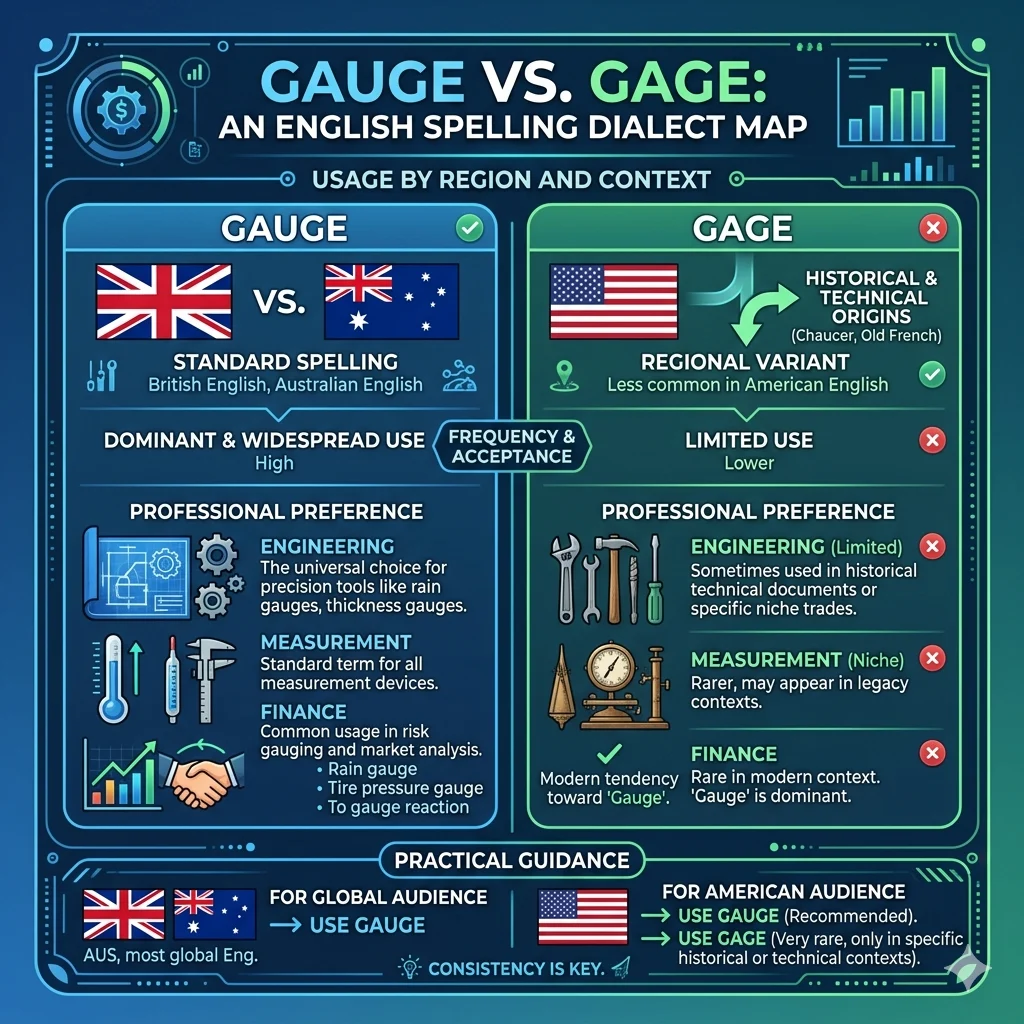
🌍 Gage or Gauge — UK vs USA vs Australia
| Country / Region | Which Spelling? | Notes |
|---|---|---|
| United Kingdom (UK) | Gauge only | Gage is not used in British English |
| United States (USA) | Gauge preferred | Gage used in engineering/technical fields |
| Australia | Gauge only | Follows British English |
| Canada | Gauge preferred | Gage may appear in technical documents |
| India | Gauge only | Follows British English standard |
| South Africa | Gauge only | Follows British English standard |
Key point: If you are writing for a global audience, always use gauge. It is understood and accepted everywhere. Gage is only safe in American technical writing.
🏭 Gage vs Gauge Engineering
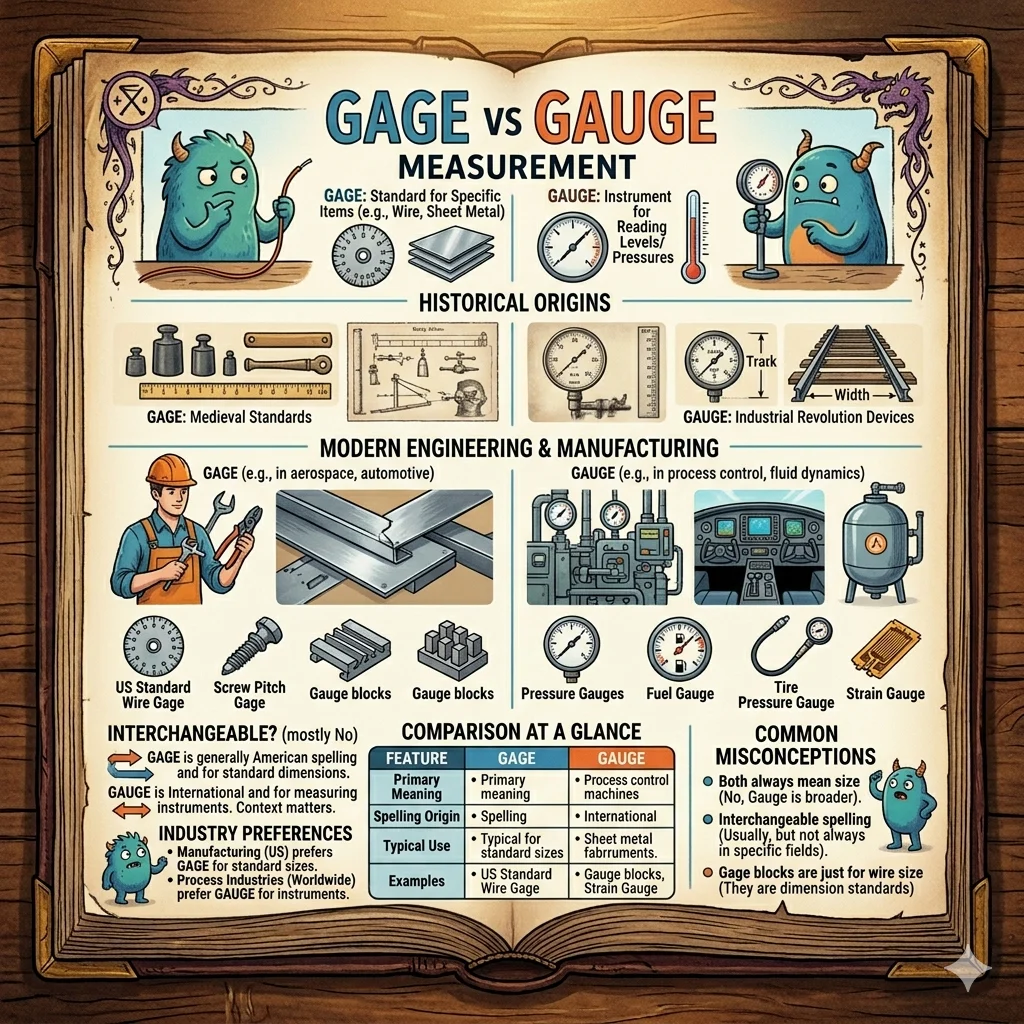
In engineering and manufacturing, both spellings appear — but they are used in slightly different ways.
When engineers use “gage”:
- American Wire Gage (AWG) — the standard system for measuring wire thickness in the US
- Sheet metal gage — thickness of metal sheets
- Plug gage — a tool used to check hole size
- Pin gage — a precision measuring tool
- Strain gage — a device that measures strain on an object
- Pressure gage — sometimes written this way in older American manuals
When engineers use “gauge”:
- Pressure gauge — the instrument showing pressure levels
- Fuel gauge — the tool showing fuel levels
- Gauge tolerance — the acceptable range of measurement
- Gauge block — a precision measurement tool
Bottom line for engineering:
- If you are following American industry standards or old technical manuals → gage may appear
- If you are writing new technical documents or for an international audience → use gauge
⚙️ Gage vs Gauge Pressure
Gauge pressure (also written as gage pressure in American technical writing) refers to the pressure measured relative to the surrounding atmospheric pressure.
- Gauge pressure = Absolute pressure − Atmospheric pressure
- When your tire gauge reads 32 PSI, that is gauge pressure
- It tells you how much MORE pressure is inside compared to outside
Examples:
“The gauge pressure in the tire is 35 PSI.” “Gage pressure is used in most industrial pressure measurements.”
Both “gauge pressure” and “gage pressure” mean the exact same thing. The spelling difference is just British/international vs. American technical usage.
📏 Gage vs Gauge Measurement
In measurement systems, both words are used:
| Measurement Context | Common Spelling |
|---|---|
| Wire thickness (USA) | American Wire Gage (AWG) |
| Sheet metal thickness (USA) | Sheet metal gage |
| Rainfall measurement | Rain gauge |
| Tire pressure | Tire pressure gauge |
| Blood pressure | Blood pressure gauge |
| Railway track width | Rail gauge |
| Precision tools | Gauge blocks |
The official name “American Wire Gage” uses the older spelling — this is a fixed, proper name and should not be changed.
📐 Strain Gage vs Strain Gauge
A strain gage (or strain gauge) is a device used to measure how much an object bends, stretches, or compresses under force.
- In American engineering literature → strain gage
- In international and British literature → strain gauge
Both mean the same device. The spelling depends on which standard your industry follows.
📌 USGS Gage vs Gauge
The United States Geological Survey (USGS) officially uses the spelling “gage” when referring to stream-measuring stations.
“The USGS stream gage recorded record-high water levels.”
This is one of the clearest examples of official American technical use of “gage” over “gauge.” If you are writing about USGS data or stream measurements, gage is the accepted spelling in that context.
🔌 Gouge vs Gauge — Are They the Same?
No — gouge and gauge are completely different words.
| Word | Meaning |
|---|---|
| Gauge | A measuring tool or to measure/assess something |
| Gouge | To scoop out, dig, or overcharge someone (also a type of chisel) |
Examples:
“Use a gauge to measure the pressure.” (measuring) “The contractor tried to gouge us on the price.” (overcharge) “He used a gouge to carve the wood.” (tool for carving)
Do not confuse these two words — they look similar but mean completely different things.
💬 Gauge Interest Meaning / Gage Interest Meaning
One of the most commonly searched phrases is “gauge interest” or “gage interest.”
“Gauge interest” means to find out or measure how interested someone is in something — like a product, event, idea, or plan.
Correct spelling: Always gauge interest (not gage interest)
Examples:
“I sent a quick email to gauge interest in the new workshop.” “We posted a poll to gauge interest before planning the event.” “She reached out to gauge client interest before the pitch.” “It is hard to gauge his interest — he never shows much emotion.”
Is it “gage interest” or “gauge interest”? → Always gauge interest. The verb form is always spelled with “gauge” — never “gage.”
🧠 Trying to Gauge — Trying to Gage
“Trying to gauge” is the correct phrase when you mean trying to understand, assess, or measure something.
✅ Trying to gauge — correct ❌ Trying to gage — incorrect (as a verb)
Examples:
“I am trying to gauge how long the project will take.” “She was trying to gauge the mood in the room.” “We are trying to gauge whether people will support this idea.” “It is difficult to gauge how the audience will react.”
Rule: When used as a verb (action word), always spell it gauge — never gage.

🎯 Gauge a Situation / Gage a Situation
“Gauge a situation” means to assess or evaluate what is happening — to understand the circumstances before making a decision.
✅ Gauge the situation — correct ❌ Gage the situation — incorrect
Examples:
“Take a moment to gauge the situation before you respond.” “I’m trying to gauge the situation — is this a good time to talk?” “He walked into the room to gauge the situation before speaking.” “It’s difficult to gauge the situation from so far away.”
💡 More Verb Phrases Using “Gauge”
Since gauge as a verb is always spelled “gauge” — never “gage” — here are common phrases where this rule applies:
| Phrase | Meaning |
|---|---|
| Gauge interest | Find out how interested someone is |
| Gauge the situation | Assess what is happening |
| Gauge a reaction | Measure or observe someone’s response |
| Gauge public opinion | Find out what the public thinks |
| Gauge support | Find out how much support exists |
| Gauge feedback | Assess the feedback received |
| Gauge the audience | Read the mood or interest of an audience |
| Gauge the conversation | Understand the tone or direction of a conversation |
| Gauge the weather | Judge or estimate weather conditions |
| Gauge how much time | Estimate the time needed |
| Gauge someone’s response | Read how someone reacts |
All of these always use gauge — never gage.
📝 Gauge in a Sentence — Examples
Here are clear examples of gauge used correctly in different situations:
Everyday life:
“The oil gauge in my car was reading low, so I stopped at a petrol station.” “She glanced at the fuel gauge and realized she needed to stop soon.”
Assessing a situation:
“He tried to gauge the crowd’s reaction before making the announcement.” “I could not gauge how she felt from her expression alone.”
Work and professional settings:
“We ran a short survey to gauge employee satisfaction.” “The manager asked for feedback to gauge how the team was coping.”
Engineering and technical:
“The pressure gauge showed 45 PSI.” “Use a plug gauge to check the hole diameter.”
Railways:
“The railway uses standard gauge tracks across the country.”
🔤 Gauging vs Gaging — Which Is Correct?
When you turn “gauge” into its -ing form, it becomes gauging. When you turn “gage” into its -ing form, it becomes gaging.
| Word | -ing form |
|---|---|
| Gauge | Gauging ✅ |
| Gage | Gaging (technical use only) |
Examples:
“She was gauging the level of interest from the attendees.” “Gauging the situation carefully, he decided not to speak.” “The sensor is used for gaging metal thickness.” (engineering context)
For everyday writing, always use gauging.
🔤 Gaged vs Gauged — Which Is Correct?
Similarly, the past tense of gauge is gauged, and the past tense of gage is gaged.
| Word | Past tense |
|---|---|
| Gauge | Gauged ✅ |
| Gage | Gaged (technical use only) |
Examples:
“He gauged the reaction of the audience carefully.” “We gauged public opinion through a series of surveys.”
🔤 Gages vs Gauges
The plural of gauge is gauges, and the plural of gage is gages.
“The factory uses several gauges to monitor pressure levels.” “We need new gauges for the laboratory equipment.”
In everyday English, always use gauges — not gages.
🔄 Is “Guage” a Word?
No — “guage” is not a word. It is simply a very common misspelling of gauge.
Many people accidentally type “guage” because the letters A and U feel natural to swap. But the correct order is always G-A-U-G-E.
Other common wrong spellings:
- Guage ❌
- Guague ❌
- Gague ❌
- Gauage ❌
All of these are misspellings. The correct word is always gauge.
📊 Gage vs Gauge — Complete Comparison Table
| Feature | Gage | Gauge |
|---|---|---|
| Standard spelling | ❌ | ✅ |
| British English | ❌ | ✅ |
| Australian English | ❌ | ✅ |
| American general writing | ❌ | ✅ |
| American engineering/technical | ✅ (sometimes) | ✅ |
| Used as a verb | ❌ | ✅ |
| Abstract meaning (assess, judge) | ❌ | ✅ |
| Measuring tool | ✅ (limited) | ✅ |
| Pressure measurement | ✅ (American technical) | ✅ |
| Wire thickness (AWG) | ✅ (official name) | ✅ |
| USGS stream stations | ✅ (official) | ✅ |
| Global / SEO writing | ❌ | ✅ |
| Safe for all audiences | ❌ | ✅ |
🌐 Google Trends — Gage vs Gauge Usage Data
Search trends clearly show:
- Gauge dominates worldwide in general searches
- Gage spikes in:
- United States engineering searches
- Manufacturing and machining communities
- Wire gauge / AWG related searches
- USGS water data searches
Common searched phrases include:
- gage vs gauge pressure
- gage vs gauge interest
- gage or gauge for thickness
- trying to gage or gauge
- how do you spell gauge

✅ Which Spelling Should You Use?
Use GAUGE if:
- ✅ You are writing for a general audience
- ✅ You are publishing online, in media, or on social media
- ✅ You are a student writing an essay or report
- ✅ You are writing professionally or academically
- ✅ You are unsure which one to use
- ✅ You want your writing understood everywhere in the world
- ✅ You are using it as a verb (to gauge interest, gauge the situation)
Use GAGE if:
- ✅ You work in U.S. engineering or manufacturing
- ✅ You are writing about American Wire Gage (AWG)
- ✅ You are following specific American industry standards or manuals
- ✅ You are referring to USGS stream measurement data
- ✅ You are working with strain gage sensors in American technical literature
When in doubt — always choose GAUGE. It is correct everywhere.
⚠️ Common Mistakes with Gage vs Gauge
Mistake 1: Using “gage” as a verb ❌ “She tried to gage public opinion.” ✅ “She tried to gauge public opinion.”
Mistake 2: Spelling gauge as “guage” ❌ “The fuel guage shows empty.” ✅ “The fuel gauge shows empty.”
Mistake 3: Thinking gauge pressure and gage pressure are different They are NOT different. Both mean the same thing — pressure measured relative to atmospheric pressure. The spelling difference is just regional.
Mistake 4: Confusing gauge with gouge ❌ “They tried to gauge out the wood with a chisel.” (wrong word) ✅ “They tried to gouge out the wood with a chisel.” ✅ “They used a gauge to measure the pressure.” (correct use)
Mistake 5: Writing “trying to gage” instead of “trying to gauge” ❌ “I am trying to gage the situation.” ✅ “I am trying to gauge the situation.”
Mistake 6: Writing “guage” instead of “gauge” This is the most common misspelling. Remember: AU comes before GE — just like “August.”
📋 Quick Reference — Gage vs Gauge in Everyday Phrases

| Phrase | Correct Version |
|---|---|
| Gage interest / Gauge interest | Gauge interest ✅ |
| Gage the situation / Gauge the situation | Gauge the situation ✅ |
| Gage a reaction / Gauge a reaction | Gauge a reaction ✅ |
| Gage public opinion / Gauge public opinion | Gauge public opinion ✅ |
| Gage the audience / Gauge the audience | Gauge the audience ✅ |
| Gage feedback / Gauge feedback | Gauge feedback ✅ |
| Trying to gage / Trying to gauge | Trying to gauge ✅ |
| Pressure gage / Pressure gauge | Pressure gauge ✅ (or gage in US technical) |
| Wire gage / Wire gauge | Both accepted (AWG uses gage) |
| Strain gage / Strain gauge | Both accepted (gage in US technical) |
| Fuel gage / Fuel gauge | Fuel gauge ✅ |
| Rain gage / Rain gauge | Rain gauge ✅ |
❓ FAQ — Gage vs Gauge: All Your Questions Answered
Q: What is correct — gage or gauge? A: Gauge is correct in almost all situations. Gage is a limited variant used mainly in American engineering and technical fields.
Q: Is it “gage interest” or “gauge interest”? A: Always gauge interest. When used as a verb — to measure or assess — the spelling is always gauge.
Q: Is it “trying to gage” or “trying to gauge”? A: Always trying to gauge. The verb form is always gauge.
Q: Is it “gage the situation” or “gauge the situation”? A: Always gauge the situation. Gage is never correct as a verb.
Q: How do you spell gauge correctly? A: G-A-U-G-E. A common misspelling is “guage” — remember the AU comes before GE.
Q: How do you pronounce gauge? A: It is pronounced GAYJ — like “page” or “age.” The “u” is silent.
Q: What is the difference between gage and gauge? A: They mean the same thing — a measuring tool or standard. Gauge is the standard spelling worldwide. Gage appears in American technical and engineering writing.
Q: Is it gage or gauge in the UK? A: In the UK, only gauge is used. Gage is not part of British English.
Q: Is it gage or gauge in Australia? A: In Australia, only gauge is used — following British English spelling.
Q: What does gauge mean as a verb? A: To gauge means to estimate, assess, or judge something — especially something not physical, like a mood, opinion, or situation. Example: “I tried to gauge how he felt.”
Q: What is gage pressure vs gauge pressure? A: They mean exactly the same thing — pressure measured relative to atmospheric pressure. “Gage pressure” is the American technical spelling; “gauge pressure” is the standard international spelling.
Q: What is a plug gage or plug gauge? A: A plug gage (or plug gauge) is a precision tool used to check whether a hole is the correct size. The “gage” spelling is common in American manufacturing.
Q: What is a pin gage or pin gauge? A: A pin gage (or pin gauge) is a small cylindrical measuring tool used to check hole diameters precisely.
Q: What is a strain gage vs strain gauge? A: Both refer to the same device — a sensor that measures how much something bends or stretches. “Strain gage” is the American technical spelling; “strain gauge” is the international spelling.
Q: What does USGS gage mean? A: USGS stands for United States Geological Survey. They officially use the spelling “gage” for their stream-measuring stations that monitor water levels in rivers.
Q: Is guage a word? A: No. “Guage” is simply a misspelling of gauge.
Q: Is gage a name? A: Yes! Gage is both a first name and a last name. Famous examples include Thomas Gage (British general) and Phineas Gage (famous medical case). It is also a popular modern first name in America.
Q: What is greengage? A: A greengage is a type of small, sweet, green plum. The word “gage” in its name comes from Sir William Gage, who introduced the fruit to Britain.
Q: What does “gauge your interest” mean? A: It means to find out how interested you are in something. For example: “I wanted to gauge your interest before planning the event.”
Q: What is the difference between gouge and gauge? A: Gauge = a measuring tool or to assess something. Gouge = to scoop out or to overcharge someone. They are completely different words.
Q: What is “gauge” in railways? A: In railways, gauge refers to the distance between the two rails on a train track. Standard gauge is 4 feet 8.5 inches wide.
Q: How do I know when to use gage vs gauge? A: Simple rule — if you are writing for a general audience, always use gauge. Only use gage if you are writing American engineering or technical documents that specifically follow that standard.
Q: What does “better gauge” mean? A: “Better gauge” means a more accurate or improved way of measuring or assessing something. Example: “This survey gives us a better gauge of customer satisfaction.”
Q: Is it “difficult to gage” or “difficult to gauge”? A: Always difficult to gauge. The verb is always spelled gauge.
Q: What does “gauge where we are” mean? A: It means to assess or understand the current situation or progress. Example: “Let us gauge where we are before making any decisions.”
Q: What is gauge in microns? A: Gauge measurements can sometimes be converted to microns (a unit of length). This is common in measuring very thin materials like plastic film or metal foil.
🏁 Conclusion
The confusion around gage vs gauge comes from history, regional differences, and specialized technical usage. But the answer is actually simple:
- Gauge is the correct and standard spelling for almost everything — everyday writing, journalism, science, education, and professional communication worldwide.
- Gage survives mainly in American engineering, manufacturing, and specific technical systems like American Wire Gage (AWG) and USGS stream measurement.
- As a verb — to assess, measure, or judge — it is always gauge, never gage.
- As a noun — a measuring tool or standard — it is almost always gauge, with gage appearing only in specific American technical contexts.
- “Guage” is never correct — it is simply a misspelling of gauge.
When you are unsure, choose gauge. It is universally understood, accepted in every English-speaking country, and correct in both formal and informal writing.
Now you know everything there is to know about gage vs gauge — so the next time you need to gauge a situation, assess someone’s interest, or check a pressure gauge, you will spell it right every single time. 😊

Tessa Hadley, a reflective voice at SimileHub.com, transforms everyday moments into vivid imagery, guiding writers to create powerful, expressive comparisons.