Most boilers should be serviced once every 12 months. That is the interval most manufacturers ask for, and it is also the interval that many landlords and warranty terms assume. The date is easy to forget, because a boiler that heats the house every morning gives you no reason to think about it.
So why does a working boiler need a yearly visit? And does an older or newer boiler change the answer? In this guide we look at what the check involves, what happens when it is skipped and how to fit it into the year.
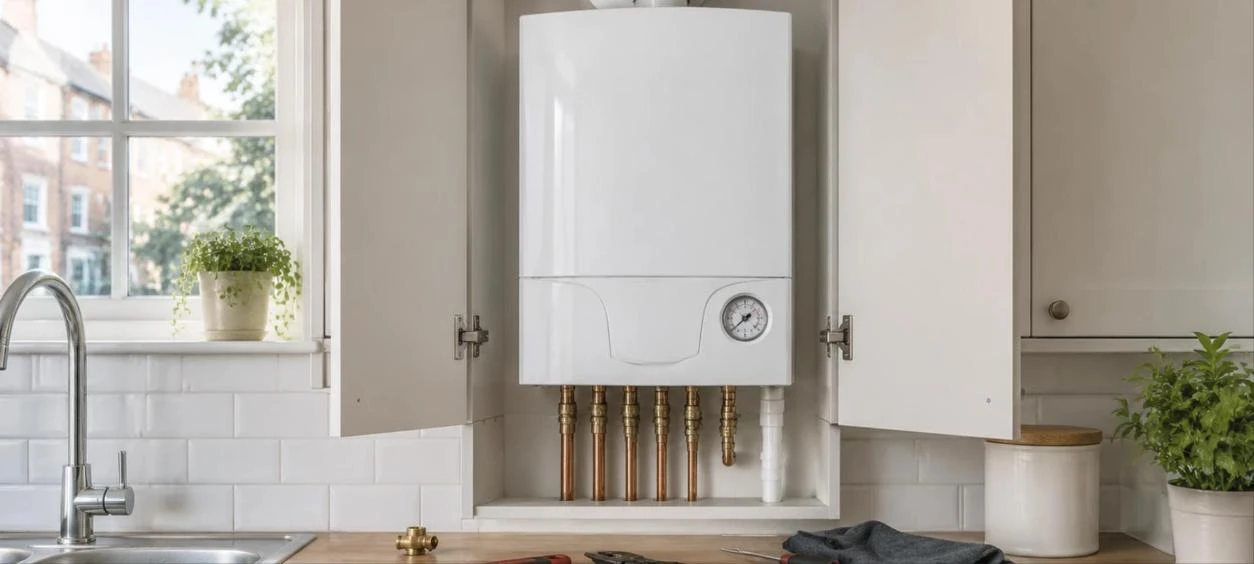
How often should a boiler be serviced in practice?
Once a year is the standard answer for gas, oil and LPG boilers. The reason is wear. A boiler fires thousands of times a season, and parts such as the burner, the heat exchanger, the fan and the seals slowly collect dirt or lose their tolerance.
Your manual is the first place to look, because the maker sets the interval for that model. Some warranties stay valid only if the boiler is serviced on time and the visit is recorded. If the manual says 12 months, a gap of 18 months can put the warranty at risk.
Age matters too. A boiler over ten years old often has more worn parts, so a yearly check is more useful, not less. A new boiler still needs its first service after 12 months, because the maker’s cover usually depends on it.
What a service visit covers
A service is a check of the whole appliance, not a quick look at the casing. An engineer will normally:
- Inspect the burner, the flame and the heat exchanger.
- Test the flue and check that the gases leave the property safely.
- Look at the seals, the pressure and the safety devices.
- Clean the parts that collect soot, scale or dust.
- Run the boiler and test how it responds.
Say your boiler has run well all winter. The check may still find a flue seal that has started to perish. It costs little to replace now. If the seal fails in January, the fault can switch the boiler off or let fumes into the room.
What happens when a service is skipped
A skipped service rarely causes an instant failure. The problems build slowly. The boiler burns less efficiently, so it can use more fuel for the same heat. Small faults stay hidden until they stop the boiler on the coldest night of the year.
Safety is the larger issue. A badly burning gas boiler can produce carbon monoxide, a gas with no smell. A yearly check is one of the few things that catches the early signs of this, together with a working carbon monoxide alarm.
When to book the visit
Many people book in late summer or early autumn, before the heating season starts. Engineers are busy in the first cold weeks, and a boiler that fails then has to wait in the same queue as everyone else.
If you rent, ask who arranges the service. In England, landlords have a duty to keep gas appliances in safe order and to arrange a yearly gas safety check. A landlord’s check is a safety inspection. It is not always a full manufacturer’s service, so ask for both if the boiler is old.
Choosing who does the work
For gas boilers, the engineer must be on the Gas Safe Register. Ask to see their ID card before they start and match the work listed on it to your boiler type.
If you want an annual boiler service, choose a local, Gas Safe registered boiler service in London with a free quote. A proper gas boiler service records what was checked and tells you plainly about any fault. The service report is useful later, for a warranty claim or when you sell the home, and regular boiler servicing in London helps you catch wear early.
Signs that your boiler needs a check sooner
Do not wait for the date if you notice any of these:
- The boiler makes new noises, such as banging or whistling.
- The pressure keeps falling or rising.
- The flame looks yellow or orange instead of blue.
- Black marks appear around the appliance.
- Radiators take much longer to warm up than before.
If you smell gas or suspect carbon monoxide, leave the property and call the National Gas Emergency Service on 0800 111 999.
What a service does not replace
A service is a check, not a cure. If the engineer finds a worn pump or a cracked part, the repair is a separate job. That is normal, and a good report will list it clearly with a reason. Ask which findings are urgent and which can wait until the next visit, so you can plan around them.
Take a boiler that passes its service but has a pump close to the end of its life. The engineer notes it on the report. You now know to expect a repair within a year, instead of finding out when the heating stops in the middle of winter.
A simple yearly routine
Put the service date in your calendar when it is done, and set the reminder for 11 months ahead. Keep the report with your boiler manual. Test your carbon monoxide alarm at the same time. A habit like this takes about ten minutes a year, and it removes the surprise from heating bills and breakdowns.
Keep a service record
Ask for a written record after every visit and keep it with the boiler manual. A good record lists the date, the work done, any readings taken and anything the engineer advised you to watch. Over several years it shows how the boiler is ageing and helps a new engineer see what has already been checked.
If a warranty applies, the record may also be needed to show that servicing was kept up. Check the terms for your model rather than assuming.
Getting ready for the visit
A little preparation makes the visit smoother and often shorter. Clear the space around the boiler so the engineer can reach it. Note any changes since the last visit, such as new noises, slower hot water or a pressure that drops. Make sure someone is home who can say how the heating is used day to day.
- Clear access to the boiler and the flue terminal outside
- A list of any faults or odd behaviour
- The previous service record, if you have one
- Details of any alarms, such as a carbon monoxide alarm that has sounded
Different fuels, same principle
Gas boilers are the most common in London homes, but oil and LPG boilers also need a yearly check. The details of the work differ because the fuel and burner differ, but the aim is the same: find wear early, confirm that combustion is clean and make sure the safety devices still work.