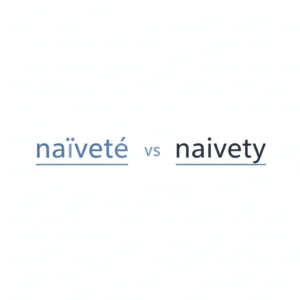
Naïveté and naivety have the same meaning. Both describe innocence, lack of experience, or simple trust. The difference is spelling style.
Naïveté is the original French spelling. It uses two dots over the “i,” called a diaeresis.
Naivety is the simplified English spelling. It removes the dots and changes the ending.
Example:
- Her naïveté made her trust everyone.
- His naivety showed when he believed the fake email.
Both are correct. The choice depends on region and tone.
Many writers stop and think when they see naïveté vs naivety. Both words look right. Both sound similar. But which one should you use? This small spelling choice can confuse students, bloggers, and even professionals. Some people ask, “Which is correct, naivety or naïveté?” Others wonder, “Is naivety the same as naive?” The confusion grows because one spelling has two dots, and the other does not. In this guide, you will learn the clear difference, the meaning, pronunciation, grammar rules, and when to use each form. By the end, you will feel confident choosing the right spelling for your audience and writing style.
The Origin of Naïveté vs Naivety
The word comes from French. Naïveté entered English in the 1600s from the French word “naïveté,” which means naturalness or innocence. The base word is “naïve,” also French.
Why does naive have two dots? The two dots over the “i” are called a diaeresis. They show that the vowels are pronounced separately. So “naïve” is said as “na-eev,” not “nave.”
Over time, English speakers simplified many French words. They removed accent marks. They also changed endings to fit English spelling patterns. That is how naivety developed.
So, naïveté is closer to French.
Naivety is more English in style.
Both forms are accepted in modern dictionaries. The spelling difference exists because English often adapts foreign words in different ways.
British English vs American English Spelling
Spelling rules often differ between British and American English. This affects naïveté vs naivety too.
In American English:
- Writers often prefer naïveté in formal writing.
- Accent marks are sometimes kept in borrowed words.
In British English:
- Naivety is more common.
- Accent marks are usually removed.
Here is a simple comparison:
| Feature | Naïveté | Naivety |
|---|---|---|
| Origin | French spelling | English adaptation |
| Accent marks | Yes (ï, é) | No |
| Common in US | Yes, especially formal | Also used |
| Common in UK | Less common | More common |
| Meaning | Innocence, simplicity | Same meaning |
In global writing, both forms appear. Style guides decide which is preferred.
Can’t vs Cannot: The Real Difference Explained
Which Spelling Should You Use?
The best choice depends on your audience.
If you write for the United States:
Naïveté may look more refined. It is common in academic and literary writing.
If you write for the UK or Commonwealth countries:
Naivety is often safer and more familiar.
If you write for a global audience:
Choose one form and stay consistent. Consistency matters more than style.
If your brand voice is simple and modern:
Naivety may feel cleaner.
If your tone is formal or artistic:
Naïveté may fit better.
There is no grammar mistake in either form. The key is clarity and consistency.
Common Mistakes with Naïveté vs Naivety
Many writers make small errors when using these words.
- Mixing spellings in one article
Wrong: Her naïveté showed her naivety.
Correct: Choose one spelling and use it everywhere. - Confusing naive with naivety
Naive is an adjective.
Naïveté or naivety is a noun. - Misspelling as naivet
Naivet is incorrect in modern English. Always add the final “e” or “y.” - Using accents incorrectly
Do not write naive with one dot. It must be naïve if you use the accent. - Overthinking the grammar
Naïveté vs naivety grammar rules are simple. Both are singular nouns. The plural is rare but can be written as naïvetés or naiveties.
Naïveté vs Naivety in Everyday Examples

Here is how the word appears in real life.
In emails:
“Your naivety about online scams worries me.”
In news writing:
“The policy revealed the government’s naïveté.”
In social media:
“His naivety vs experience debate is trending.”
In academic writing:
“The study explores political naïveté among young voters.”
In casual speech:
“She showed pure naivety when she trusted strangers.”
Both forms work in daily communication. The meaning stays the same: innocence or lack of experience.
Naïveté vs Naivety – Google Trends & Usage Data
Search data shows that both spellings are popular. In the United States, naïveté often appears in academic and literary contexts. In the United Kingdom, naivety appears more often in newspapers and blogs.
Online discussions like naïveté vs naivety reddit threads show users asking which is correct. Most responses say both are correct, but preference depends on region.
Search queries such as:
- Naïveté vs naivety pronunciation
- Naïveté vs naivety meaning
- Naïveté or naivety meaning
- Naivete or naivety pronunciation
These searches prove people want clarity, not just spelling rules.
Digital content creators often choose the simpler form, naivety, because it is easier to type on mobile devices.
Comparison Table: Naïveté vs Naivety vs Naivet
| Word | Correct? | Meaning | Usage Level |
|---|---|---|---|
| Naïveté | Yes | Innocence, lack of experience | Formal, literary |
| Naivety | Yes | Same meaning | Common, modern |
| Naivet | No | Incorrect spelling | Avoid |
This table helps writers choose quickly.
Myself vs Me: The Real Difference Made Simple
FAQs
1. Which is correct, naivety or naïveté?
Both are correct. The difference is spelling style, not meaning.
2. Is naivety the same as naive?
No. Naive is an adjective. Naivety is a noun describing the quality of being naive.
3. Why does naive have two dots?
The two dots show separate vowel sounds. This comes from French spelling rules.
4. What does naïveté mean?
It means innocence, simplicity, or lack of experience.
5. Naïveté vs naivety pronunciation – is it different?
No. Both are pronounced the same: “nah-eev-tee.”
6. Is naiveté meaning different from naivety meaning?
No difference in meaning. Only spelling changes.
7. Should I use naïveté vs naivety in formal writing?
In US academic writing, naïveté is common. In UK writing, naivety is common.
Conclusion
Naïveté vs naivety is not a battle of right or wrong. It is a choice of style. Both words mean innocence or lack of experience. Both are accepted in English. The difference comes from history. One spelling keeps its French roots. The other follows English patterns.
If you write for American readers, naïveté may feel more traditional or academic. If you write for British readers, naivety may look more natural. For global content, consistency is key. Pick one spelling and use it throughout your work.
Do not confuse the noun with the adjective naive. Remember that accent marks are optional in English but must be used correctly if chosen. Avoid incorrect forms like naivet.
In the end, your audience matters more than the accent marks. Clear writing builds trust. Choose wisely, stay consistent, and your message will always be strong.

Ali Smith, a passionate language artist at SimileHub.com, turns simple words into vivid imagery, helping writers express emotions with beauty and clarity.