Have you ever paused while writing “somebodies” or “somebody’s” and wondered which one is correct? You’re not alone. This tiny apostrophe can completely change the meaning of your sentence, leaving readers confused or misinterpreting your message.
Many people search for Somebodies vs somebody’s meaning because they want to write clearly in emails, essays, social media, and professional documents. Understanding this difference is not just about grammar—it’s about credibility.
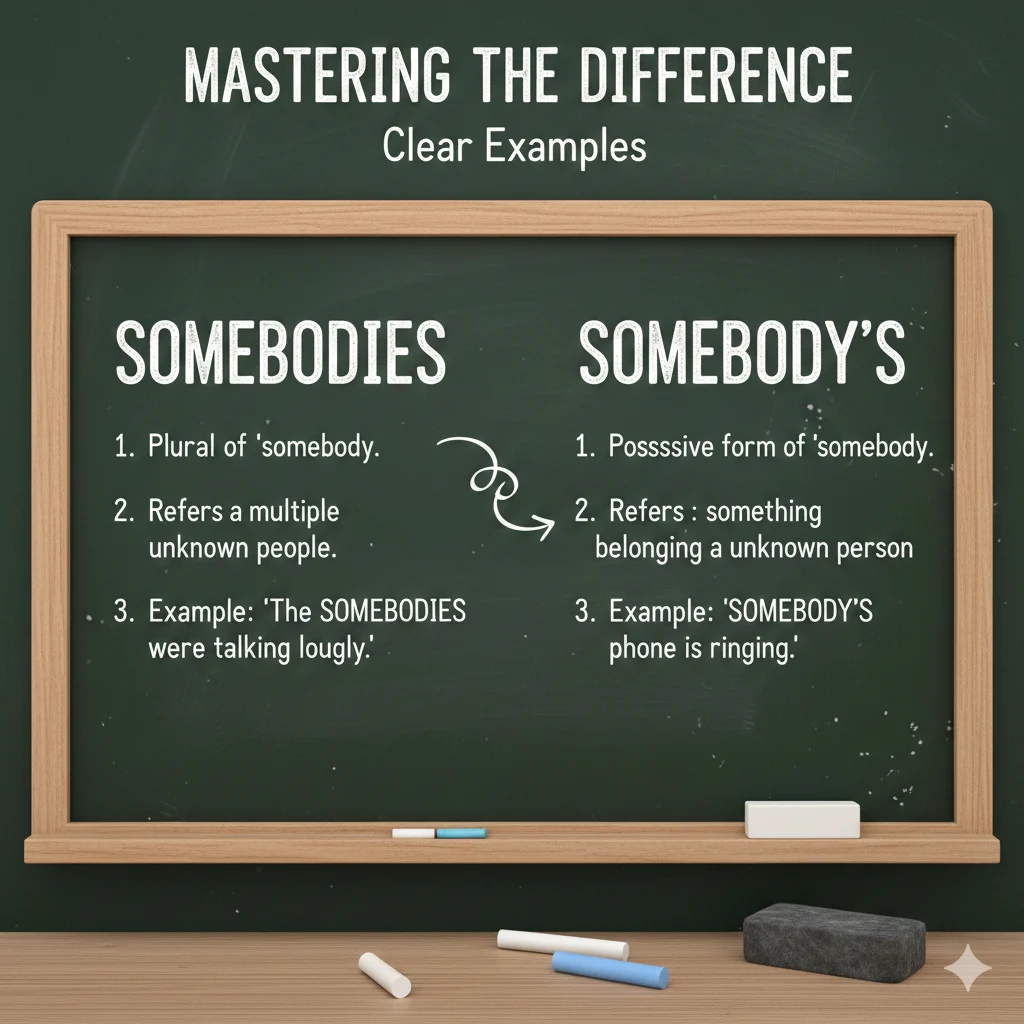
Confusion often arises because English uses both singular and plural forms, as well as possessive forms. Somebodies is the plural of “somebody,” referring to multiple people. Meanwhile, somebody’s is a contraction of “somebody is” or a possessive, indicating something belonging to somebody. A misplaced apostrophe can make your writing look unprofessional or even change the entire sentence meaning.
In this article, we’ll break down Somebodies vs somebody’s with quick answers, historical origins, British vs American usage, common mistakes, and real-life examples. By the end, you’ll know exactly when to use each form—perfect for grammar enthusiasts, students, writers, and professionals.
Somebodies vs Somebody’s means
The simplest way to remember:
- Somebodies → plural of “somebody” (more than one person).
Example: “There were many somebodies at the party.” - Somebody’s → possessive or contraction of “somebody is.”
Examples:- Possessive: “Somebody’s jacket is on the chair.”
- Contraction: “Somebody’s calling you.”
Think of it this way: if you can replace it with “someone owns” → somebody’s; if you are talking about multiple people → somebodies.
Table: Quick Comparison
| Form | Meaning | Example |
|---|---|---|
| Somebodies | Plural of somebody | “Several somebodies joined us.” |
| Somebody’s | Possessive / Somebody is | “Somebody’s phone is ringing.” |
This quick guide helps answer the most common query: “What is the difference between somebody’s and somebodies?”
The Origin of Somebodies vs Somebody’s
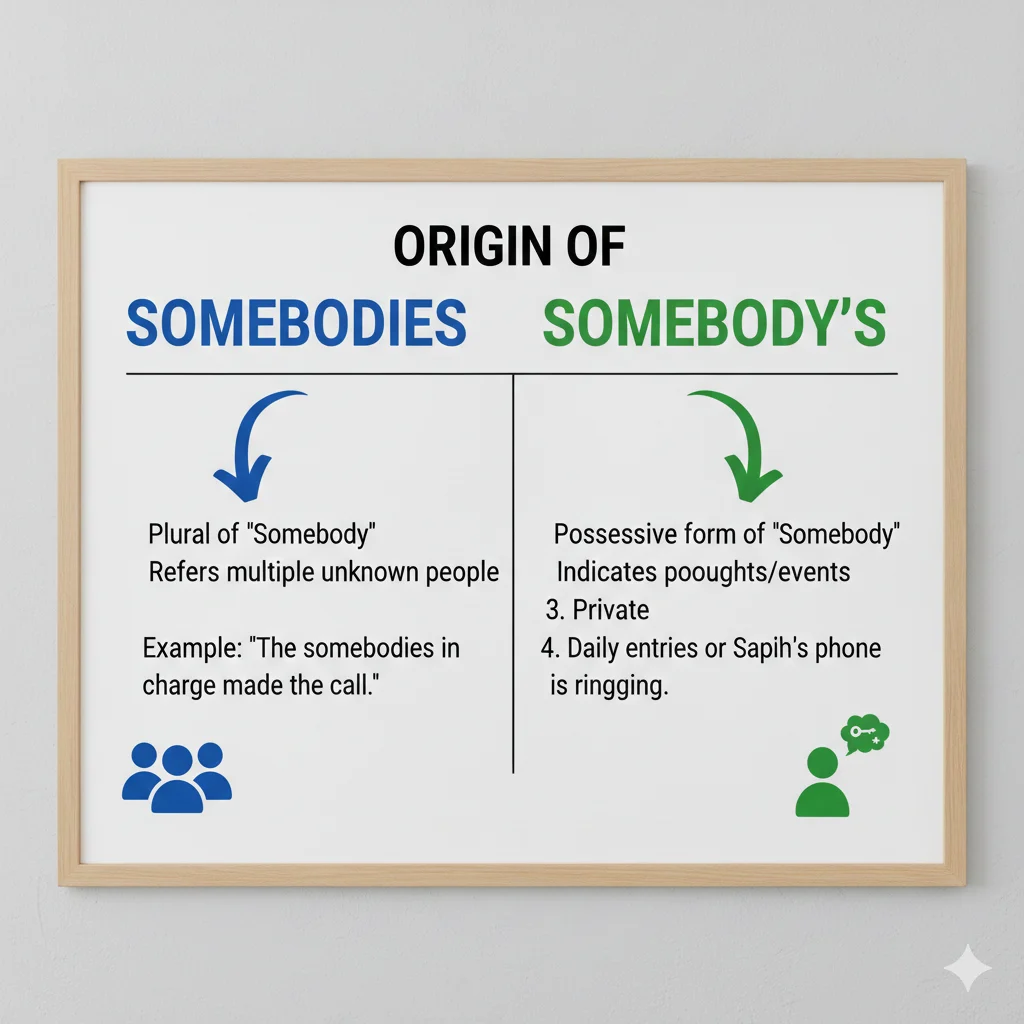
The words somebody and somebodies have been part of English since the Middle English period (12th–15th centuries). English evolved from Old English and borrowed words from French, Latin, and Germanic languages.
- Somebody → a single person, from Middle English sum bodi.
- Somebodies → simply the plural form to indicate multiple individuals.
The possessive somebody’s comes from the grammatical rule of adding an apostrophe + “s” to show ownership or contraction. This rule became standard in Modern English around the 16th century.
So the difference isn’t random—it’s historical. English speakers have always relied on context and punctuation (like the apostrophe) to differentiate plural and possessive forms.
British English vs American English Spelling
Luckily, the difference between somebodies and somebody’s is consistent across British English (BrE) and American English (AmE). However, small spelling conventions can cause confusion elsewhere.
- In British English, apostrophes are often used more strictly in contractions and possessives.
- In American English, contractions are widely accepted in both formal and informal writing.
Examples
| Form | British English Example | American English Example |
|---|---|---|
| Somebodies | “A few somebodies were waiting.” | “A few somebodies were waiting.” |
| Somebody’s | “Somebody’s umbrella is wet.” | “Somebody’s umbrella is wet.” |
| Contraction | “Somebody’s going to the shop.” | “Somebody’s going to the store.” |
💡 Key Tip: Apostrophe rules are universal for somebody’s, but always double-check if writing for formal UK publications.
Which Spelling Should You Use?
Choosing the correct form depends on context and audience:
- Plural form – Somebodies: Use when referring to multiple unknown people. Common in literature, journalism, and casual conversation.
Example: “The conference attracted several somebodies from different industries.” - Possessive / Contraction – Somebody’s: Use when showing ownership or shortening “somebody is.”
Examples:- Possessive: “Somebody’s notebook was left behind.”
- Contraction: “Somebody’s waiting outside.”
- Audience consideration:
- US readers: Contractions like somebody’s are widely acceptable.
- UK readers: Possessive form is formal and standard.
Rule of Thumb: If you mean plural → somebodies. If you mean possession or contraction → somebody’s.
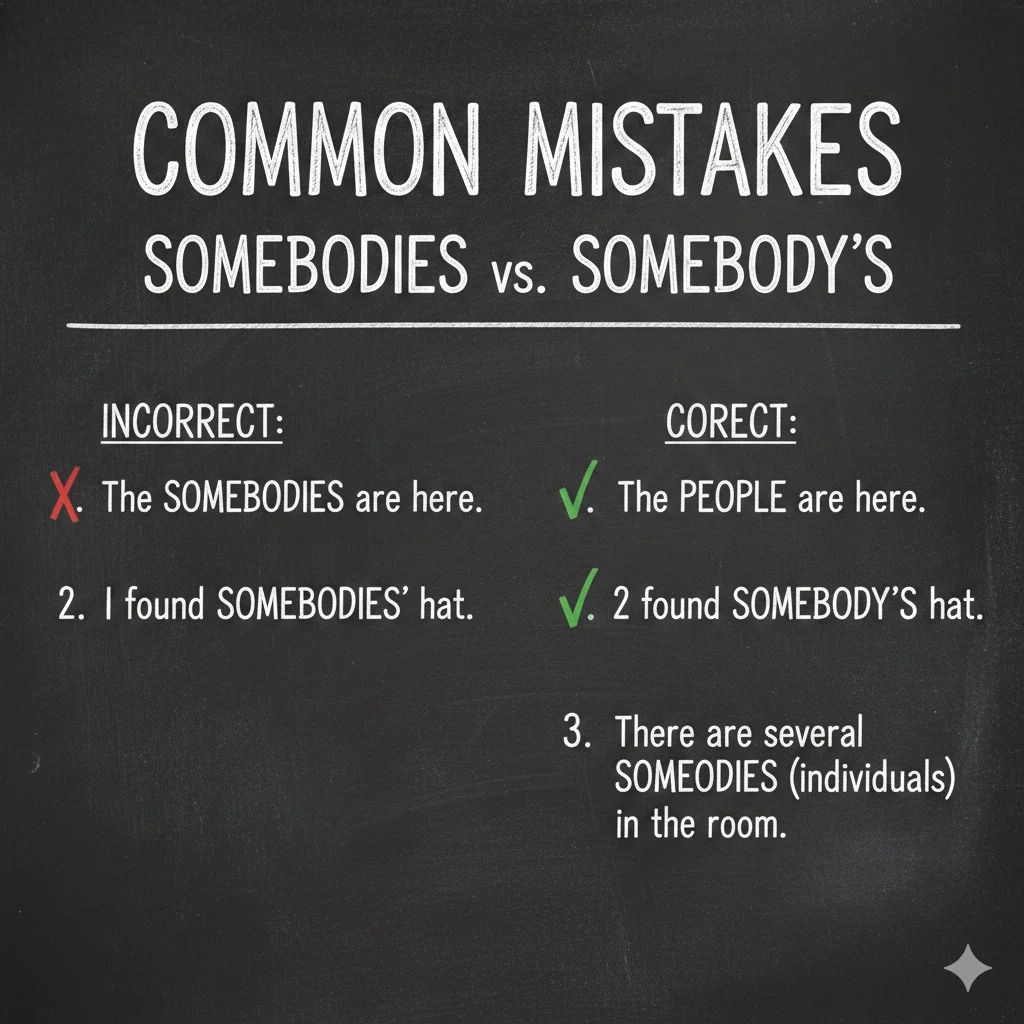
Common Mistakes with Somebodies vs Somebody’s
Even native speakers make these errors:
- Misplacing the apostrophe
❌ “The party had many somebody’s.”
✅ “The party had many somebodies.” - Using plural instead of possessive
❌ “Somebodies jacket is missing.”
✅ “Somebody’s jacket is missing.” - Overusing contractions in formal writing
❌ “Somebody’s going to the office tomorrow.” (formal essay)
✅ “Somebody is going to the office tomorrow.” - Confusing with “someone” or “some body”
❌ “Some body left their book.”
✅ “Somebody left their book.”
By practicing examples and quizzes (Somebodies vs somebody’s quiz), writers can reduce mistakes.
Somebodies vs Somebody’s in Everyday Examples

Emails:
- Correct: “Somebody’s request has been approved.”
- Incorrect: “Somebodies request has been approved.”
Social Media:
- “Several somebodies showed up at the event!”
- “Somebody’s tweet went viral last night.”
News Headlines:
- “Somebody’s actions caused a major stir.”
- “The town celebrated with dozens of somebodies recognized.”
Formal Writing:
- Use the possessive without contractions for clarity:
“Somebody’s opinion matters in this discussion.”
Somebodies vs Somebody’s – Google Trends & Usage Data
Google Trends shows that searches for Somebodies vs somebody’s meaning peak among students, writers, and ESL learners.
- Top countries searching: USA, UK, Canada, Australia.
- Popular queries include:
- “Somebodies vs somebody’s reddit”
- “Somebodies vs somebody’s grammar”
- “Somebodies vs somebody’s examples”
📊 Trend Insight: People frequently search for this keyword when writing essays, professional emails, or social media posts.
Keyword Variations Comparison Table
| Keyword Variation | Use Case | Correct Form in Sentence |
|---|---|---|
| Somebodies meaning | Explaining plural form | “Somebodies means more than one somebody.” |
| Somebody plural or singular | Grammar clarification | “Somebody is singular; somebodies is plural.” |
| Is somebodies a word | Dictionary check | “Yes, somebodies is the plural of somebody.” |
| Is somebody’s grammatically correct? | Grammar check | “Yes, somebody’s is correct for possessive/contraction.” |
| Difference between somebody and some body | Clarification of space usage | “Somebody is one word; some body is rarely correct.” |
| Difference between somebody and someone | Synonym comparison | “Somebody is informal; someone is more formal.” |
FAQs About Somebodies vs Somebody’s
Q1: Is somebodies a word?
Yes, it’s the plural of “somebody” referring to multiple people.
Q2: What is the difference between somebody’s and somebodies?
Somebodies → plural.
Somebody’s → possessive or contraction.
Q3: Can I use somebody’s in formal writing?
Yes, but avoid contractions. Prefer “somebody is” in essays or reports.
Q4: How do I remember the difference?
If it shows ownership → use somebody’s. If plural → use somebodies.
Q5: Is somebody singular or plural?
Somebody is singular; somebodies is plural.
Q6: What is the difference between somebody and someone?
Both mean a person, but “someone” is slightly more formal and widely used in writing.
Q7: Can “somebodies” refer to important people?
Yes, sometimes in informal English “somebodies” can mean people of influence.
Conclusion
Understanding Somebodies vs somebody’s is simpler than it looks. The key is to distinguish between plural forms and possessive/contractions. Use somebodies when referring to multiple people and somebody’s when indicating ownership or contracting “somebody is.”
The confusion often arises because English combines plural, possessive, and contraction forms, but consistent practice and examples make it easy. Whether you are writing emails, essays, news posts, or social media updates, following these rules ensures clarity and professionalism.
Remember the quick trick: “ownership or contraction → somebody’s; more than one person → somebodies.” Check your work against examples, take short quizzes like Somebodies vs somebody’s quiz, and explore usage on forums like Reddit to see real-life examples. By mastering this subtle distinction, you not only improve grammar but also increase confidence in your writing.
Correct usage of these words is a small detail with a big impact on how readers perceive your credibility.

Sarah Hall, a passionate voice at SimileHub.com, blends poetic depth with clear guidance to help writers craft vivid imagery and unforgettable expressions.