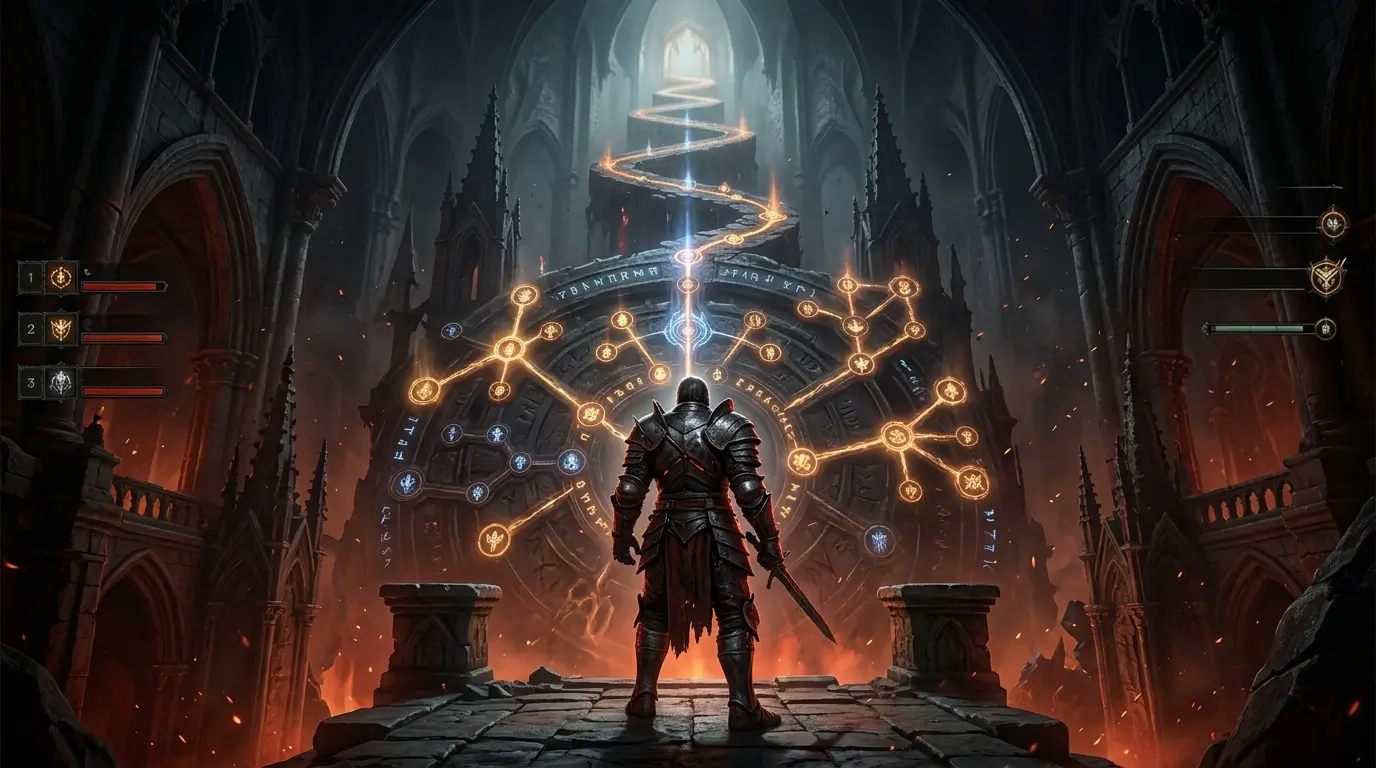
Every action RPG ends the same way: the campaign finishes, the credits roll somewhere you barely notice, and the real game begins — a long numerical climb toward a ceiling most players will never touch. Diablo 4’s version of that ceiling is Paragon 300, and in the community it has acquired a reputation: the slowest grind in the genre, a number quoted the way mountaineers quote death zones. With Season 15 opening this week — alongside the game’s brand-new Switch 2 release pulling in a wave of fresh players who are about to meet the Paragon board for the first time — it’s the right moment to test the reputation against the genre’s other famous grinds. Is Diablo 4’s climb really the slowest? The honest answer: it depends entirely on which part of the climb you’re measuring.
How the System Works Now
For the newcomers and the lapsed: character levels in Diablo 4 stop at 60, and everything after is Paragon — points fed into sprawling boards of stat nodes, glyphs, and rare bonuses, capped at 300. Two structural facts define the modern system. First, Paragon is account-wide within a realm: your points serve every character on the seasonal realm, which turned alt-making from a tax into a perk. Second, it resets seasonally — each season starts the climb fresh (your progress converts into the non-seasonal Eternal realm rather than vanishing), which means the Paragon grind isn’t a once-per-game mountain like some rivals’ — it’s a recurring one, four times a year.
This year raised the stakes around it. The Lord of Hatred expansion in April brought two new classes — Paladin and Warlock — and a fresh region to grind through, and this month’s BlizzCon settled the game’s long-term shape: no further expansions are planned, with Blizzard committing Diablo 4 to seasonal content while Diablo 5 heads for 2029. Translation: the Paragon climb, in roughly its current form, is the endgame for the long haul.
The Shape of the Curve: Fast Floor, Brutal Ceiling
The defining feature of Diablo 4’s climb is how unevenly it’s distributed. The early Paragon bands fall quickly — a focused seasonal player rides the XP curve through the first couple of hundred points at a satisfying clip, powered by whatever the season’s densest farming activity happens to be. Then the curve turns. The final stretch toward 300 is where the reputation comes from: per-point XP requirements balloon, and the last few dozen points cost more play time than everything before them combined. The community shorthand is accurate enough — most engaged players finish a season somewhere in the 200s, and full 300 remains a badge for the streamers, the no-lifers, and the deeply stubborn.

The Genre Comparison
So — slowest in ARPGs? Line the famous grinds up and the picture gets interesting:
|
Grind |
Structure |
What makes it brutal |
What softens it |
|---|---|---|---|
|
Diablo 4 — Paragon 300 |
Capped, account-wide, resets seasonally |
Exponential curve at the top; recurring every season |
Early bands are fast; alts share progress |
|
Diablo 3 — Paragon |
Uncapped, infinite |
Literally never ends |
No wall — just a smooth, optional forever |
|
Path of Exile — Level 100 |
Capped, per character |
XP loss on death at high levels; one mistake erases hours |
It’s optional — most builds are complete around 95 |
|
Last Epoch — Level 100 |
Capped, per character |
Steep terminal curve |
Builds finish long before the cap; no death penalty |
|
Grim Dawn — Level 100 |
Capped, per character |
Length, mostly |
Gentle curve by genre standards |
The comparison reveals what “slowest” hides. Path of Exile’s level 100 is arguably crueler — the death-penalty design means the grind can move backwards, something Diablo 4 never does. Diablo 3’s Paragon is longer — infinite, by definition — but its smooth optionality means nobody experiences it as a wall. What Diablo 4 built is distinct: a hard, visible, finite ceiling placed just past the reach of a normal season, recurring four times a year. It isn’t the slowest grind in the genre by raw hours to some endpoint. It’s the genre’s most repeated long grind — and repetition, not length, is what the complaints are actually about.
Where the Wall Actually Starts
For the practical player, the system divides cleanly into two games. Below roughly the mid-200s, Paragon is simply what happens while you play the season: run the seasonal activity, push the pit or the season’s equivalent ladder, and the points arrive. Past that line, Paragon becomes the point of playing — deliberate high-density farming, optimized builds, and hours that scale exponentially per node. That’s also precisely the line where the time-market forms every season: players who want a specific season’s build fully online — the glyph levels, the final board nodes, the last stretch a padded work schedule won’t cover — book a diablo 4 boost for exactly the segment of the curve where each point costs an evening, and keep the earlier, denser, more fun part of the climb for themselves. It’s a rational split: the front of the curve is gameplay; the back of the curve is arithmetic.
The Verdict
Is Diablo 4’s Paragon climb the slowest grind in ARPGs? Measured per point at the very top — it’s among the steepest, deliberately. Measured as a total once-per-game project — Path of Exile’s death-taxed 100 and Diablo 3’s literal infinity both out-brutal it. The fairer verdict is that Diablo 4 made a specific design bet: a finite ceiling that almost nobody hits, reset seasonally, so the mountain regrows every quarter. Whether that’s genius retention design or a treadmill in mountain’s clothing is the community’s forever-argument, and with seasons now confirmed as the game’s whole future, it won’t be settled soon. What’s certain is the practical read for this week’s Season 15 wave, Switch 2 newcomers included: enjoy the fast 200, respect the slow 100, decide in advance which player you are — and if you ever want a second opinion on where that line sits for your build and schedule, the team at https://xboosty.com spends every season mapping exactly that curve. The mountain isn’t going anywhere. That’s the entire point of it.

Elara Quinn is a digital communication writer specializing in emoji meanings, online messaging, and internet culture. She creates clear, accurate, and reader-friendly content that helps readers understand emojis, symbols ,and modern digital communication. Her goal is to make online conversations easier through practical ,easy to follow guides and reliable information. Elara is passionate about creating helpful content that keeps readers informed about the latest digital communication trends.