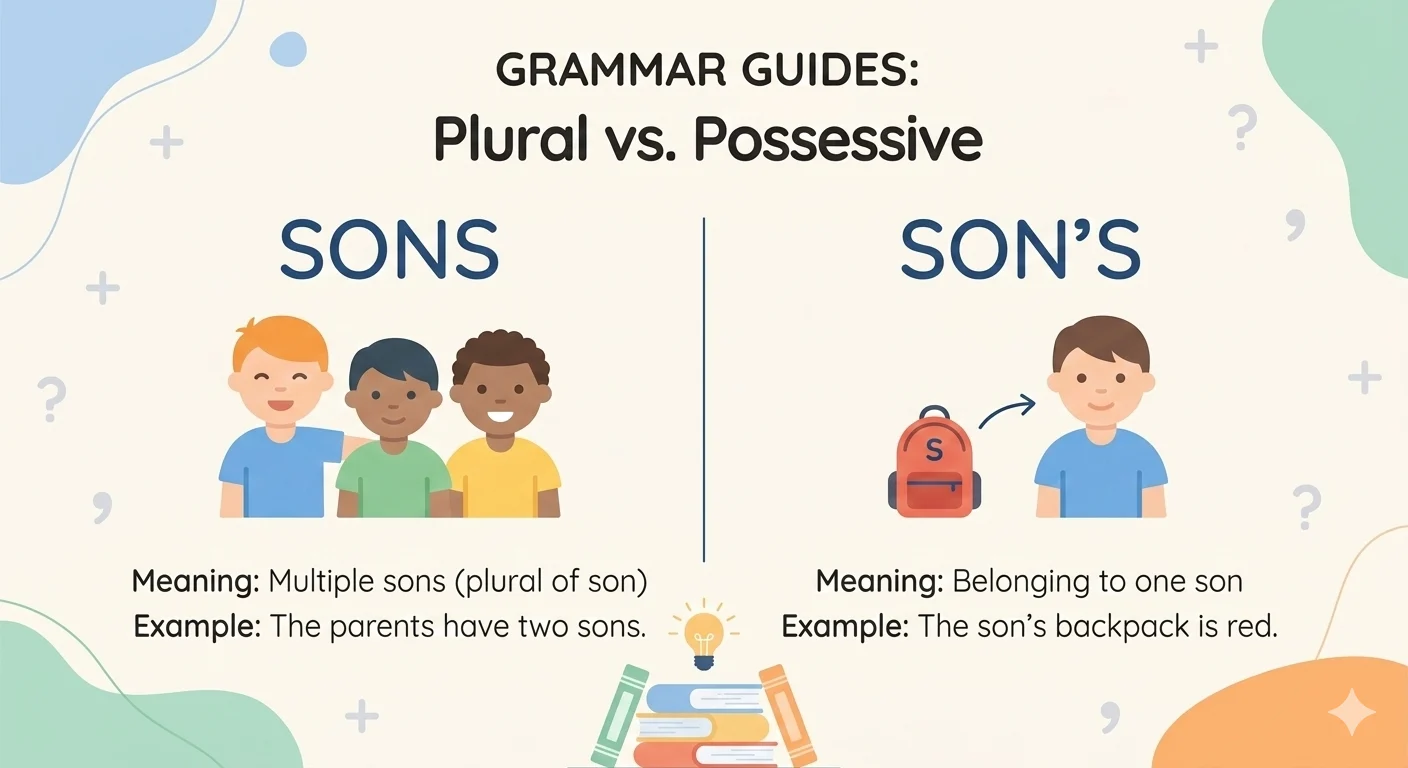
Sons vs Son’s is a common English grammar mistake where “sons” means more than one son, while “son’s” shows possession or something belonging to one son.
Many learners confuse sons and son’s because a single apostrophe can completely change the meaning of a sentence. For example, sons is used when talking about multiple sons: “The sons are playing outside.” But son’s is used when something belongs to one son: “The son’s book is on the table.”
The key difference is simple but very important. Sons = plural (more than one son), while son’s = possessive (belonging to one son). Understanding this rule helps avoid one of the most common writing errors in English grammar.
A common mistake is using an apostrophe with plural words or forgetting it in possessive form, which can make sentences confusing or incorrect. That is why learning the correct use of sons vs son’s is important for clear writing in exams, emails, and everyday communication.
In short, sons refers to multiple sons, and son’s shows ownership. Once you remember this simple rule, you can easily avoid confusion and write more accurately in English.
plural of son

Sons.
That’s it. Simple, right?
The plural of “son” is sons – just add an S at the end. No apostrophe. No extra letters. No tricky rules.
- One son → son
- Two sons → sons
- Three sons → sons
Here’s how it works:
| Form | Example |
|---|---|
| Singular | “My son is five years old.” |
| Plural | “My sons are both in school.” |
The Golden Rule: Never use an apostrophe to make a word plural.
❌ Wrong: “I have two son’s.”
✅ Correct: “I have two sons.”
💡 Quick trick: If you’re talking about more than one son, just add S. No apostrophe. Ever.
The Origin of Sons vs Son’s
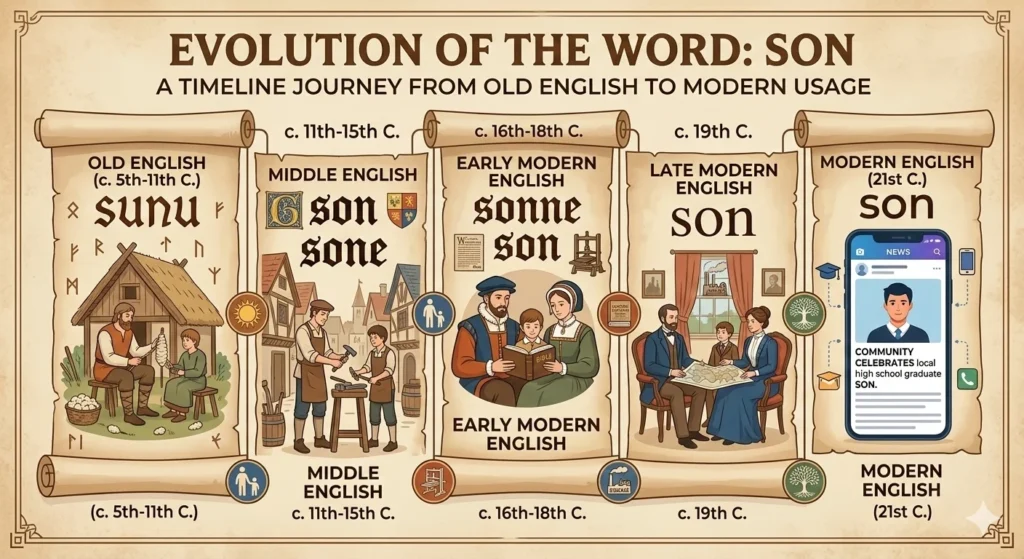
The word son comes from Old English sunu, used for centuries to describe a male child. English later developed plural and possessive forms using different grammar systems.
How the forms evolved
- Plural rule: English added -s to show more than one object.
Example: son → sons. - Possessive rule: English added apostrophe + s to show ownership.
Example: son → son’s.
These rules appeared during Middle English writing reforms when punctuation became standardized.
The confusion exists because both forms look almost identical. The only difference is the apostrophe, yet it signals a completely different grammatical function.
Historically, apostrophes were introduced to replace missing letters, but later they became markers of possession. That is why modern English separates plural and possessive meanings visually.
British English vs American English Spelling
Good news: there is no spelling difference between British and American English for sons vs son’s. Both follow the same grammar rules.
However, style differences appear when dealing with family names and possessive endings.
Comparison Table
| Usage Type | British English | American English | Example |
|---|---|---|---|
| Plural noun | sons | sons | The sons arrived. |
| Singular possessive | son’s | son’s | The son’s room |
| Plural possessive | sons’ | sons’ | The sons’ toys |
| Family name possessive | Jones’s or Jones’ | Jones’s preferred | The Jones’s house |
Example Sentences
- UK and US: My son’s teacher called today.
- UK and US: Their sons play football.
So the grammar remains consistent worldwide.
Superseded vs Superceded: Which Spelling Wins? 🏆
Which Spelling Should You Use?
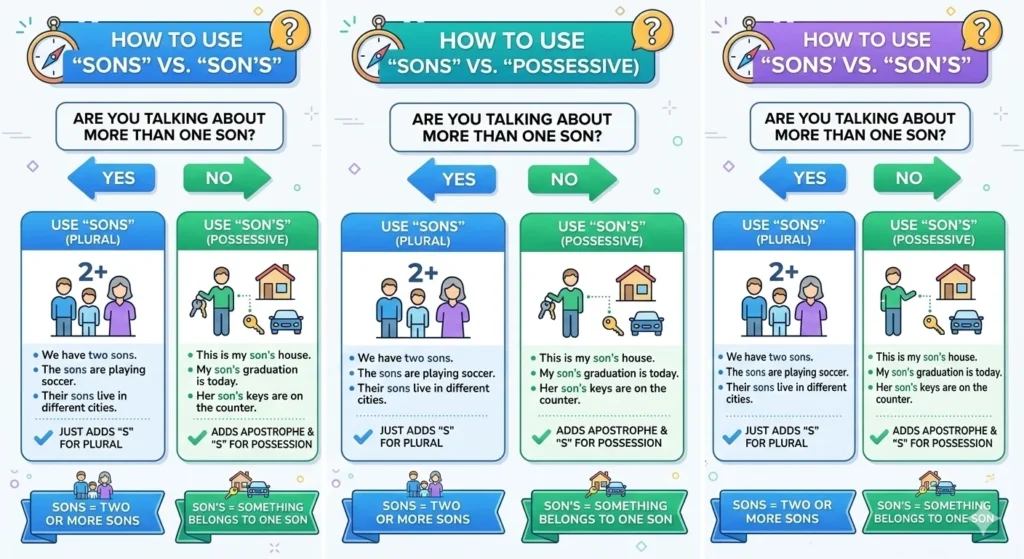
Choosing between sons and son’s depends on meaning, not location.
Use sons when:
- Talking about more than one child.
- Writing general statements.
- Describing groups.
Example:
- My two sons quotes always make me smile.
Use son’s when:
- Something belongs to one son.
- Showing ownership.
Example:
- My son’s homework is finished.
Audience-Based Advice
| Audience | Recommended Usage |
|---|---|
| United States | Follow standard possessive apostrophe rules |
| UK/Commonwealth | Same grammar rules apply |
| Global writing | Keep apostrophe usage clear and simple |
If your audience is international, avoid complex punctuation and write short clear sentences.
when to use sons or son’s
Sons = more than one son. No apostrophe.
Son’s = something belongs to one son. Apostrophe.
| Use | Example |
|---|---|
| sons (plural) | “My sons are here.” |
| son’s (possessive) | “My son’s bag is red.” |
💡 Quick trick: If you mean “belongs to him” → add apostrophe. If you mean “more than one” → don’t.
Common Mistakes with Sons vs Son’s
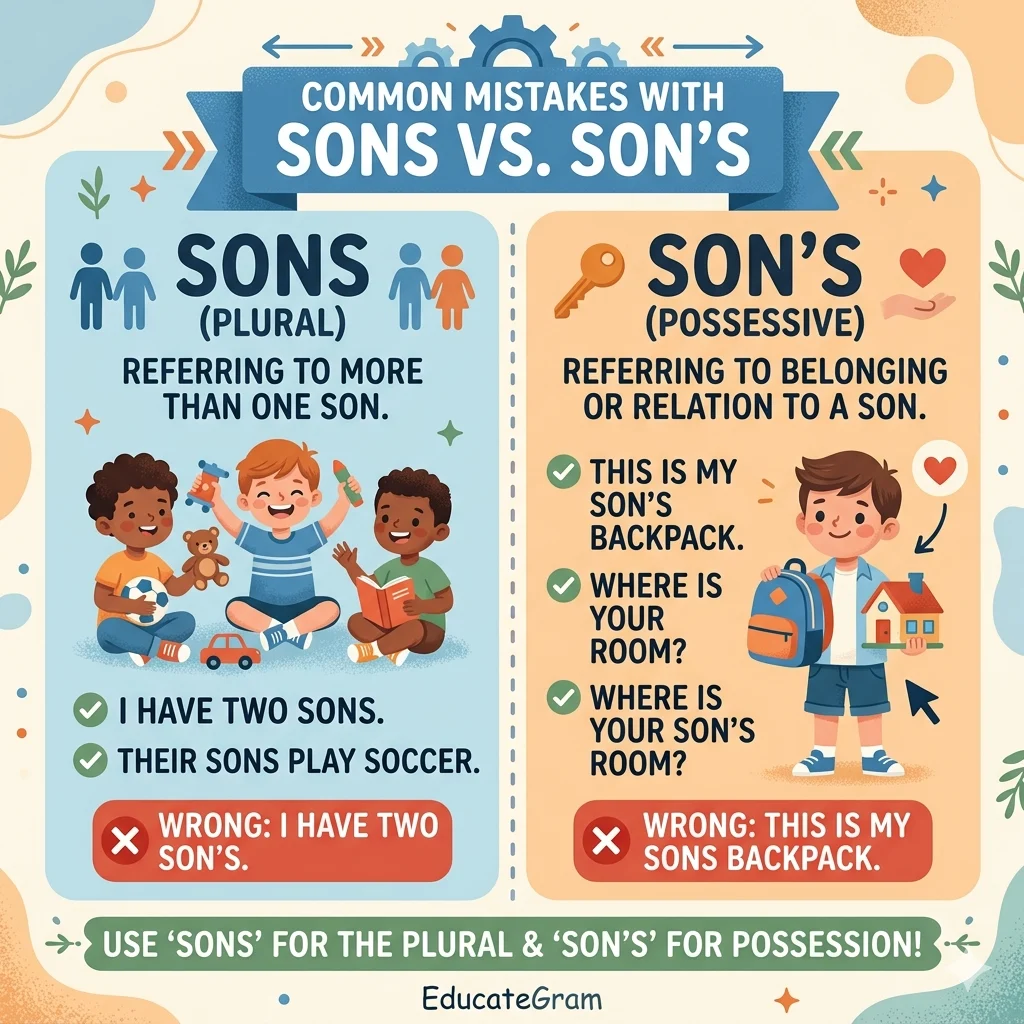
Many writers misuse apostrophes because they assume every word ending in s needs one.
Frequent Errors
❌ I love my son’s.
✅ I love my sons.
❌ The sons bike is red.
✅ The son’s bike is red.
❌ My sons’s school is large.
✅ My sons’ school is large.
Why mistakes happen
- Apostrophes are confused with plurals.
- Fast typing causes punctuation errors.
- Auto-correct tools miss grammar context.
Remember: apostrophes never make a word plural.
is it sons or son’s
It depends on what you’re trying to say.
Here’s the quick answer:
- Use sons when talking about more than one son.
- Use son’s when talking about something that belongs to one son.
Let me make it crystal clear:
| You want to say… | Use this | Example |
|---|---|---|
| More than one son | sons | “My sons are coming home.” |
| Something belongs to one son | son’s | “My son’s bag is heavy.” |
Still confused? Ask yourself one question:
“Am I showing ownership or just talking about multiple kids?”
- Ownership? → Add an apostrophe: son’s
- Just plural? → No apostrophe: sons
💡 The golden rule: Apostrophes show possession, never plurals. If there’s no ownership, there’s no apostrophe.
❌ Wrong: “I love my son’s.” (means you love something belonging to your son)
✅ Correct: “I love my sons.” (means you love your children)
❌ Wrong: “The sons bike is red.”
✅ Correct: “The son’s bike is red.”
does sons have an apostrophe
No.
Never.
“Sons” is a simple plural – just more than one son. You never add an apostrophe to make a word plural.
❌ Wrong: “My two son’s”
✅ Correct: “My two sons”
Only add an apostrophe when you’re showing ownership:
| Form | Meaning | Example |
|---|---|---|
| sons | More than one son | “My sons are tall.” |
| son’s | Belongs to one son | “My son’s bike is new.” |
| sons’ | Belongs to multiple sons | “My sons’ room is big.” |
💡 Golden rule: Apostrophe = ownership. No apostrophe = plural.
Sons vs Son’s in Everyday Examples
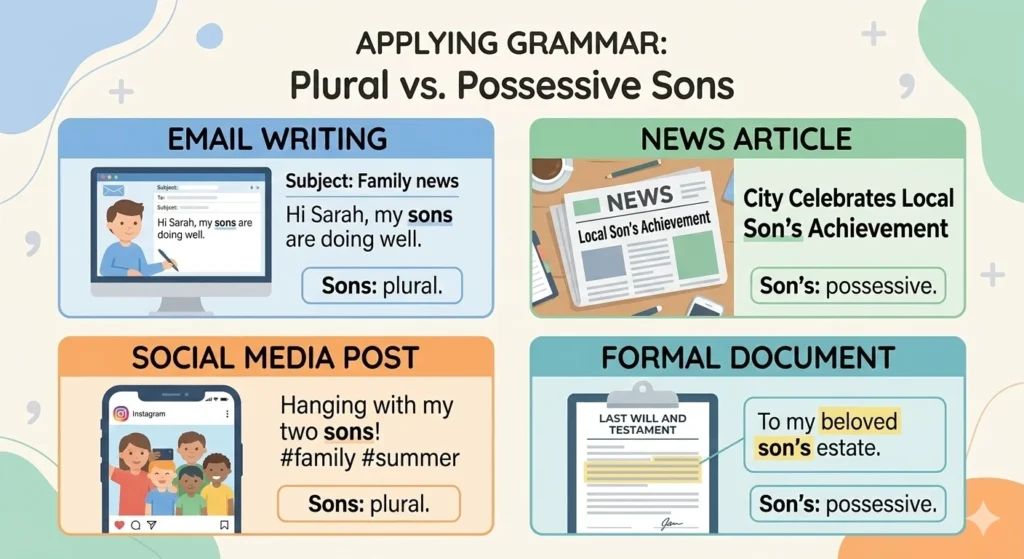
Understanding real usage helps grammar stick better.
Emails
- I will attend my son’s graduation tomorrow.
- Both sons are joining the meeting.
News Writing
- The president’s sons attended the ceremony.
- The sons of the actor spoke publicly.
Social Media
- Proud of my sons today.
- My son’s achievement made my day.
Formal Writing
- The son’s responsibilities were clearly defined.
- The sons contributed equally to the project.
Family Naming Example
People often ask: Is it the Jones or the Jones’s?
- The Jones = the family name plural.
- The Jones’s house = something owned by the Jones family.
Sons vs Son’s – Google Trends & Usage Data
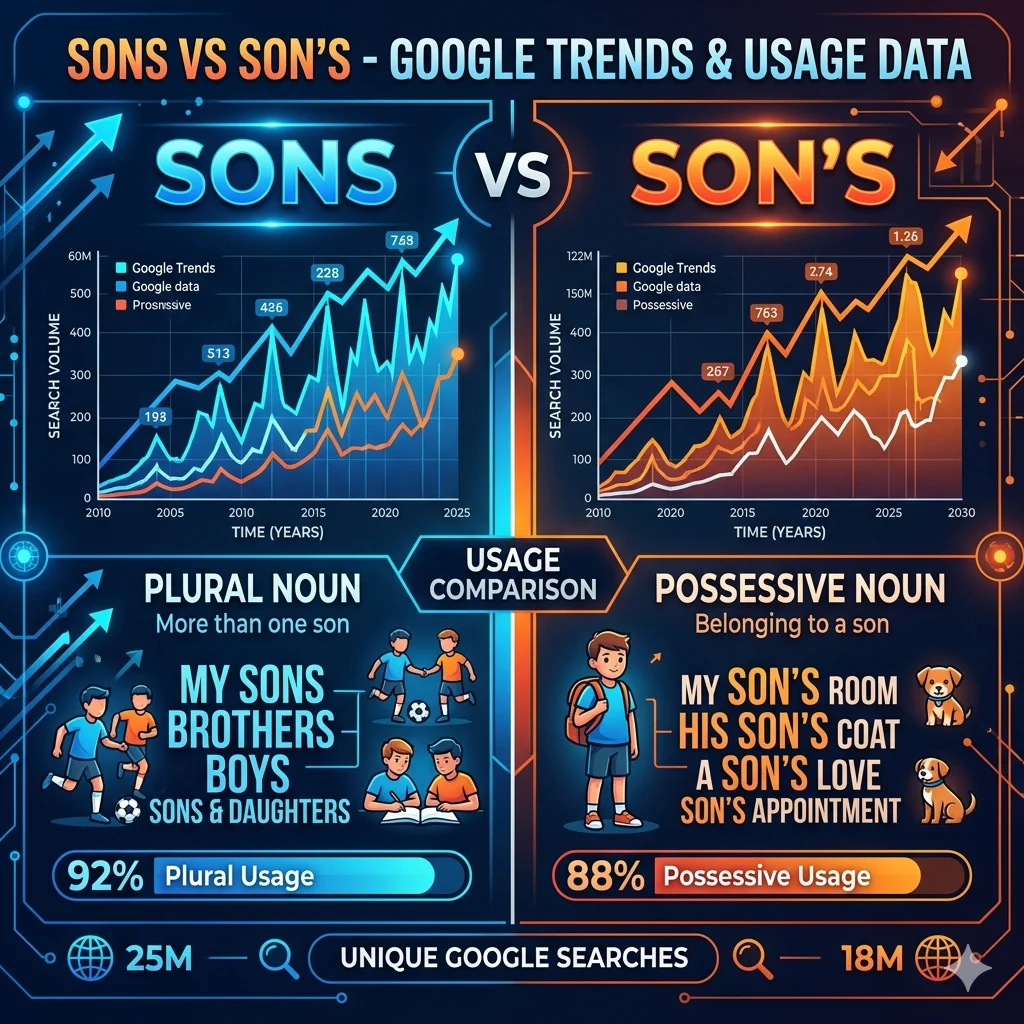
Search interest shows that many learners struggle with possessive apostrophes. Queries like sons vs son’s meaning and sons vs son’s grammar are searched globally by students and writers.
Usage Patterns
- High searches in countries where English is a second language.
- Students preparing for exams frequently search this topic.
- Parenting blogs and family writing increase usage.
Context Popularity
| Context | Common Form |
|---|---|
| Parenting articles | sons |
| Personal stories | son’s |
| Academic writing | both correctly used |
| Social media | often incorrect usage |
Grammar confusion increases because spoken English does not show apostrophes, only written English does.
Comparison Table: Sons vs Son’s Forms
| Form | Grammar Type | Meaning | Example |
|---|---|---|---|
| son | singular noun | one child | My son is happy. |
| sons | plural noun | more than one child | My sons are here. |
| son’s | singular possessive | belongs to one son | My son’s bag |
| sons’ | plural possessive | belongs to many sons | My sons’ room |
Understanding Related Grammar Questions
Is sons grammatically correct?
Yes. Sons is correct when referring to more than one son.
Is sons the plural of son?
Yes. Adding -s creates the plural form.
Sons plural possessive
When something belongs to multiple sons, add an apostrophe after the s:
- The sons’ project won an award.
Is son singular or plural in Spanish?
In Spanish, son is not related to family grammar. The word for son is hijo (singular) and hijos (plural).
Son plural in French
French uses fils for both singular and plural, but pronunciation changes in context.
My son’s son is called
Your son’s son is called your grandson.
Consentual vs Consensual 💡 The Grammar Rule You Missed
FAQs About Sons vs Son’s
1. What does sons vs son’s meaning refer to?
It explains the difference between plural form and possessive form of the word son.
2. Can sons ever show possession?
No. You must add an apostrophe to show ownership.
3. Why do people confuse sons vs son’s grammar?
Because pronunciation sounds identical in speech.
4. Is son’s always singular possessive?
Yes. It refers to something owned by one son.
5. What is the plural possessive of sons?
It becomes sons’.
6. How do I remember the rule easily?
Think: apostrophe equals ownership.
7. Are apostrophes used for plurals?
No. Apostrophes never create plurals.
What is the 7 7 7 Rule for Parenting?
The 7 7 7 rule divides childhood development into three stages:
- First 7 years: children learn through play and love.
- Second 7 years: children learn through discipline and structure.
- Third 7 years: children learn independence and identity.
Parents often discuss their sons and daughters using this framework when talking about growth stages.
My Two Sons Quotes (Usage Examples)
Writers often use plural forms naturally:
- My two sons teach me patience every day.
- Watching my sons grow is life’s greatest reward.
- My sons are my strongest motivation.
Notice that no apostrophe appears because ownership is not shown.
Conclusion
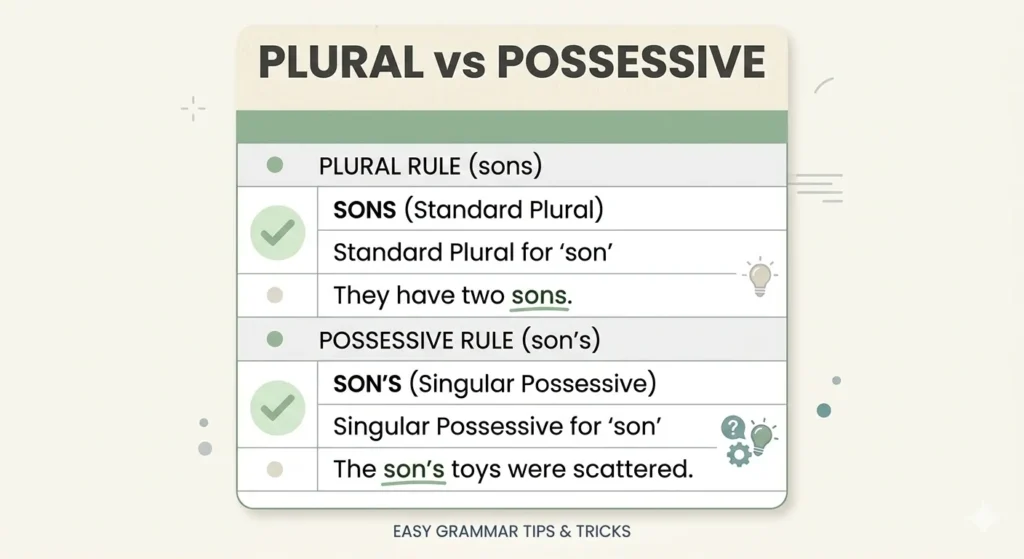
Understanding sons vs son’s becomes easy once you focus on meaning instead of spelling. Sons refers to quantity, while son’s shows ownership. This small punctuation mark carries a big grammatical role, which is why writers frequently make mistakes. Remember that apostrophes never create plurals; they only show possession.
Whether you are writing emails, academic papers, parenting stories, or social media posts, choosing the correct form improves clarity and professionalism. If you are talking about more than one child, use sons. If something belongs to one child, use son’s. When ownership involves multiple children, use sons’. Practicing with real examples helps the rule become automatic.
English grammar may seem complex at first, but many rules follow simple patterns. By understanding plural and possessive structures, you avoid common writing errors and communicate more clearly. Keep sentences short, check apostrophes carefully, and think about ownership before writing. With these steps, you will confidently use sons vs son’s correctly every time.

D.M. Thomas, a thoughtful wordsmith at SimileHub.com, blends imagination with emotion, crafting rich imagery that guides readers into deeper, vivid expression.